Châteaucore · research note
French chateau furniture: arranging a mirror, console and chair
A mirror, a console and a chair can suggest a château interior without filling the room with ornament. The challenge is to make three different forms relate to the architecture while preserving their separate identities. This guide combines a documented Versailles comparison with a practical planning method for a modern room.
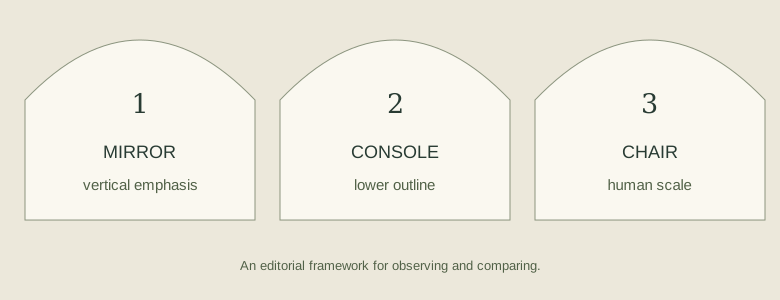
Begin with a documented room
The Château de Versailles describes the Dauphine’s Great Chamber with a preserved console placed beneath a mirror whose frame was reproduced. Its wall covering is described as a modern evocation based on inventories. That distinction is valuable: an authoritative presentation can combine surviving objects with researched reconstruction. It is therefore misleading to treat every element visible in a historic-room photograph as untouched original furnishing.
Draw the wall before choosing the mirror
Record the wall width, ceiling height, skirting, switches and any opening nearby. On a simple elevation, draw the proposed console and mirror to scale. Include the complete frame, especially projecting crests and side ornament. A mirror that fits by glass dimensions alone may still be too large. Check what it reflects from the usual entrance and seated viewpoint; a reflected doorway can change the effect more than the ornament itself.
Let the console establish the lower outline
A console may have a projecting top, shaped apron or unusually shallow body. Record these separately rather than using only a single overall width. Place a paper outline on the floor to see how the depth affects circulation. Determine the mounting and support requirements for the actual piece. A console intended for wall attachment should not be assumed to function as a freestanding table simply because it appears upright in a photograph.
Choose the chair as a usable object
A chair introduces a different scale from the vertical mirror. Decide whether it is for regular sitting or primarily for display before considering its position. The seat height, depth and arm clearance determine its practical relationship to the room. Upholstery and frame may be of different dates. Request structural and condition information rather than using the softness of the fabric or the elegance of the legs as evidence of readiness for use.
Distinguish rhythm from an invented matching set
A curved console apron and curved chair rail can create a visual relationship without having been designed together. Describe that as a modern grouping. Repeating one line or material is often enough; identical gilding is not required. Try the chair slightly away from the console so that its silhouette remains legible. Leave the mirror as the principal vertical feature and avoid small accessories that conceal the construction you wanted to appreciate.
Make the attribution language precise
An honest room record might say: later Louis-style chair, mirror with replaced glass, console with documented restoration. That is more informative than calling everything château antiques. If a seller claims a particular estate origin, request the evidence that connects the specific object to that location. A historic photograph, inventory or ownership record must be evaluated for what it actually identifies. Decorative resemblance alone cannot supply the missing chain.
| Focus | What to examine | Useful distinction |
|---|---|---|
| Mirror | Full frame and reflection | Mounting and glass history |
| Console | Top, apron and depth | Wall support and repairs |
| Chair | Seat and arm clearance | Frame condition and upholstery history |
Check the distinction
What proves that an object came from a château?
Questions about Châteaucore
Does château furniture mean furniture from a château?
Not necessarily. In retail language it can indicate an appearance. A specific place-of-use claim needs separate supporting evidence.
Must the console and mirror be a pair?
No. They can form a new arrangement, provided they are not described as an original matching pair without evidence.
Can a later Louis-style chair work?
Yes. Its design may suit the composition. Its manufacture date should still be described separately from the historical style it references.
What is the most useful first measurement?
Record the complete wall and the full dimensions of each piece, including projecting frames, tops and arms. This reveals conflicts before installation.
Return to the style guide
Châteaucore: understanding French château furniture
Look closer at the objects
Compare decorating styles
Sources and scope
- French Bedroom: a retailer’s contemporary use of Châteaucore
- Château de Versailles: the Dauphin and Dauphine’s apartments
Sources checked 16 October 2026. Historical references support the named examples; the room layouts and observation exercises are our editorial proposals. A style comparison does not authenticate an individual object.