Pottery & Stoneware · identification & value
Vintage Water Pitcher
In a Provençal farmhouse, water was carried from the well or fountain in a glazed earthenware pitcher, its interior coated in green or yellow lead glaze to keep it watertight. In Normandy, cider went to the table in a stoneware pichet, and in Brittany the Quimper pitcher was painted with a peasant in costume.
1800–1970
Verified market data (US$)
$88 – $242 – $11,550
lowest · median · highest observed
French dealers asking on Proantic: €80–10 500 (median €220, 41 listings). (Proantic prices converted to USD at 1 EUR = $1.10.)
Expert tip
Fill it at home or ask to pour water from it: an old earthenware pitcher that has crazed may weep through hairline cracks, and a pitcher that seeps is a decorative piece only; a damp ring on paper after five minutes tells you.
History
- Provençal and Drôme potteries made glazed earthenware for daily use from the 18th to the 20th century; Dieulefit and Cliousclat remained active pottery villages.
- Quimper faience pitchers with Breton figures were produced in the late 19th and 20th centuries by HB and Henriot; Villedieu-les-Poêles has made copper ware for centuries.
Where it comes from
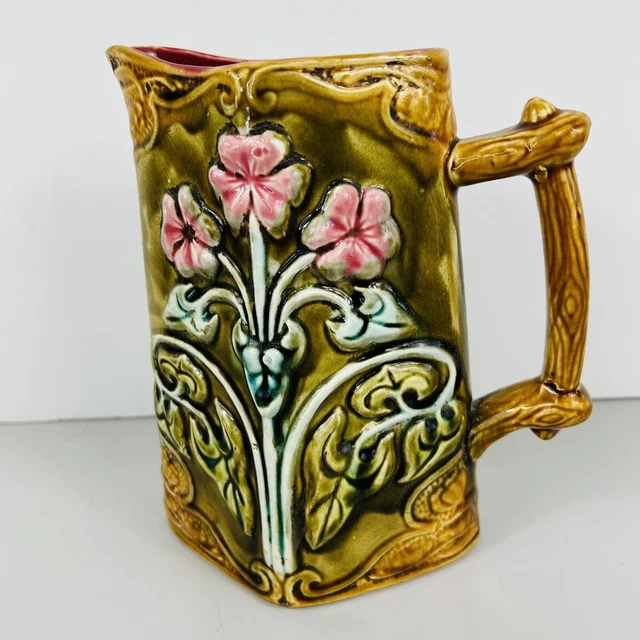
Provence and the Drôme for glazed earthenware pitchers (Dieulefit, Cliousclat, Vallauris); Normandy and Brittany for stoneware and Quimper faience pichets; Saint-Clément and Lunéville (Lorraine) for barbotine; Villedieu-les-Poêles (Manche) for copper. Amber and pressed-glass pitchers are mostly American and Italian.
Details to look at
- The glaze: lead-glazed green, honey-yellow or brown inside and out, partial glazing on the lower body, or painted faience decoration.
- The shape: round-bellied pichet, tall broc with a strap handle, pinched pouring lip, or a Normandy cider jug with a bridge spout.
- The base and marks: kiln-stilt scars, painted Quimper signatures, impressed factory stamps.
The market: most wanted
- Old Provençal and Dieulefit pitchers with deep green or yellow glaze and honest wear.
- Quimper pitchers signed HB, Henriot or HB-Henriot, especially early hand-painted figures.
- Barbotine fish and flower pitchers from Saint-Clément, Onnaing and Lunéville, and hammered copper brocs from Villedieu-les-Poêles.
Authenticity: period piece or reproduction?
- On old earthenware the glaze rubs off on the rim, handle and foot to show the red or buff clay beneath.
- Wood-fired pieces have uneven glaze with runs and specks; modern ones are uniform.
- Quimper marks changed over time: compare with a mark reference to date a piece, and look for a painter's mark.
- Warning signs: new Provençal 'style' pottery aged with tea stains, repainted or overpainted Quimper, and glued handles hidden under fresh glaze.
Where to buy
- In France: L'Isle-sur-la-Sorgue and Provençal brocantes, Dieulefit and Cliousclat pottery shops, Quimper's antique dealers, Leboncoin and Selency.
- In the US and UK: eBay and Etsy for Quimper and barbotine, Chairish for Provençal pottery, Replacements Ltd for factory patterns.
Buyer's checklist
- Hairline cracks
- Rim chips
- Glaze wear
- Marks
Facts
- Typical size
- H 15–35 cm
- Weight
- 0.5–3 kg
- Period
- 1800–1970
- Materials
- Earthenware, faience, stoneware, copper, glass
- US search interest
- 640 searches a month
Collector interest
US shoppers type 640 searches a month about water pitcher, spread over 20 keyword variants.
The styles people attach to it most are french country (10).
Most-searched materials: glass (260), copper (30), silver (20), brass (10).
Related in Pottery & Stoneware
- Vintage Pottery
- Vintage Pitcher
- Antique Delft Pottery
- Delft Tiles
- Vintage Crock
- Vintage Majolica
- Stoneware Jug
- Antique Delftware
Go deeper: research notes
The White Ironstone Pitchers: An Identification Guide gathers 11 sourced object studies, including:
- Flow blue and ironstone: colour effects do not identify the ceramic body
- Identifying an ironstone pitcher through a teapot
- New York shape: an English ironstone pitcher with an American place-name
See also: Vintage Majolica & Faience, French Confit Pots.