Pottery & Stoneware · identification & value
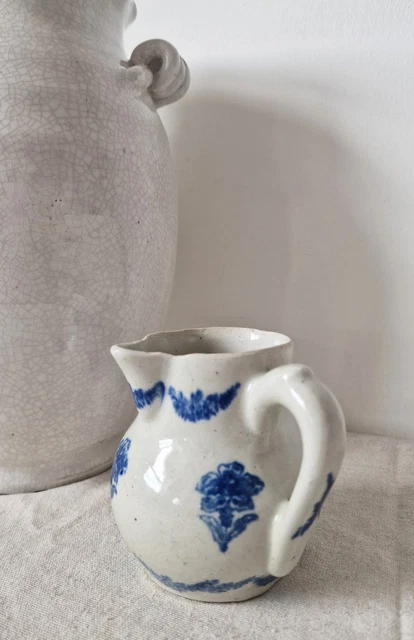
Stoneware Jug
For centuries French farms kept their cider, wine, oil and water in stoneware jugs fired hard enough not to leak. In America, salt-glazed and brown-glazed jugs held whisky, vinegar and molasses, and many still carry the stamped names of the grocers and merchants who filled them.
1800–1950
Guide price (US$)
$30 – $120 – $800
low · typical · high, dealer level
Price tip: under $30 is a bargain worth checking twice; above $800, ask for provenance or a maker's mark.
Verified market data (US$)
$132 – $605 – $13,200
lowest · median · highest observed
French dealers asking on Proantic: €120–12 000 (median €550, 60 listings). (Proantic prices converted to USD at 1 EUR = $1.10.)
Expert tip
Run a finger inside the neck and look at the base: a hand-thrown jug shows spiral throwing rings inside and a cut, slightly rough foot, while a slip-cast copy is smooth inside with an even, thin wall.
History
- Salt-glazed stoneware jugs were made in Puisaye and Alsace from the Middle Ages to the 20th century, with Alsatian pieces often decorated in cobalt blue.
- In the US, Western Stoneware Co. was formed in Monmouth, Illinois, in 1906, and its jugs with maple-leaf marks are widely collected.
Where it comes from
Puisaye (Saint-Amand-en-Puisaye) and the Beauvaisis for French salt-glazed stoneware; Normandy (Domfront area) and Alsace (Betschdorf) for grès jugs; the US market favours Western Stoneware Co. of Monmouth, Illinois.
What sets the price
Maker, glaze, size.
Details to look at
- Glaze: orange-peel salt glaze, brown slip, or two-tone with a lighter top.
- Marks: maker's stamps, capacity numbers, merchants' names and towns.
- Form: handle attachment, spout or pouring lip, and shoulder shape.
The market: most wanted
- Large salt-glazed jugs with cobalt decoration.
- Merchant-stamped jugs with legible names and towns.
- Alsatian blue-decorated jugs and early Puisaye pieces.
Authenticity: period piece or reproduction?
- Throwing marks and slight asymmetry in body and handle.
- Glaze runs, kiln scars and ash spots from firing.
- Stamps impressed into the clay before firing, not printed on top.
- Warning signs: slip-cast smoothness, freshly stamped 'old' names, and grime painted on to look aged.
Where to buy
- Regional brocantes and Leboncoin for French grès; L'Isle-sur-la-Sorgue for display groups.
- In the US, eBay, Etsy and Round Top for American stoneware. The guide range is $30–800.
Buyer's checklist
- Hairlines
- Chips at lip and base
- Marks
- Handle sound
Facts
- Typical size
- H 15–45 cm · Ø 10–25 cm
- Weight
- 1–6 kg
- Period
- 1800–1950
- Materials
- Stoneware, salt glaze, slip glaze
- US search interest
- 2,580 searches a month
Collector interest
Jug draws 2,580 monthly US searches, split into 82 keyword variants.
The materials buyers name are stoneware (1,110), glass (210), wicker (140), ceramic (140).
Searcher intent: 3% want to buy; 12% ask what it is worth.
Related in Pottery & Stoneware
- Vintage Pottery
- Vintage Pitcher
- Antique Delft Pottery
- Delft Tiles
- Vintage Crock
- Vintage Majolica
- Antique Delftware
- Vintage Stoneware Crock
Go deeper: research notes
The White Ironstone Pitchers: An Identification Guide gathers 11 sourced object studies, including:
- Flow blue and ironstone: colour effects do not identify the ceramic body
- Identifying an ironstone pitcher through a teapot
- New York shape: an English ironstone pitcher with an American place-name
See also: Vintage Majolica & Faience, French Confit Pots.