Pottery & Stoneware · identification & value
Vintage McCoy Pottery
In the early 20th century, the clay hills of southeastern Ohio supported dozens of potteries, and the McCoy family was among the best known. The Nelson McCoy company began with stoneware crocks and churns, then turned to the cheerful glazed planters, vases and cookie jars that filled American kitchens and florists' shops through the mid-century.
1910–1990
Typical asking price on live listings
about $59
Median of current eBay asking prices (via PicClick); listings run from $2.5 to $5,000. Asking prices are not sold prices.
Expert tip
Read the base and compare the mark with a dated reference: Nelson McCoy pieces from the 1930s–40s often have an 'NM' mark, later pieces 'McCoy' in block or script letters, sometimes with 'USA'; measure the piece too, as reproductions made from moulds of originals come out slightly smaller because clay shrinks in firing.
History
- The Nelson McCoy Sanitary Stoneware Company was founded in Roseville, Ohio in 1910; the separate J.W. McCoy Pottery became part of Brush-McCoy in 1911.
- Nelson McCoy produced art ware, florist ware and cookie jars from the 1930s until the factory closed around 1990.
Where it comes from
Not French: McCoy is American, from Roseville, Ohio, in the Zanesville pottery district (also home to Roseville and Weller). For French buyers, the nearest equivalents are the regional stoneware and art pottery of Vallauris and Digoin.
Details to look at
- The mark: impressed or moulded NM, McCoy in block or script, 'USA', and mould numbers, or no mark at all on some early pieces.
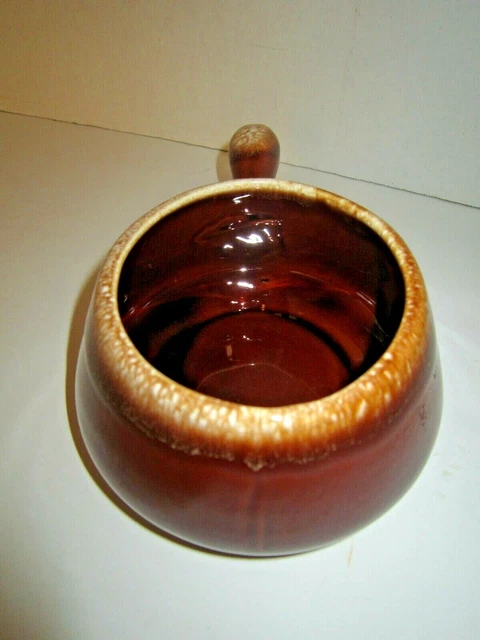
- The glaze: soft matte pastels, high gloss, brown drip and onyx-type mottled glazes, and cold-painted details on cookie jars.
- The form: cookie jars, figural planters (animals, shoes, wishing wells), florist vases, jardinières and pedestals, early stoneware.
The market: most wanted
- Rare and early cookie jars in excellent condition with intact cold paint.
- Early stoneware and art pottery with NM marks, and jardinières with matching pedestals.
- Figural planters and vases from the 1940s–50s in uncommon colours.
Authenticity: period piece or reproduction?
- Genuine pieces have crisp moulded detail; copies cast from original pieces show softer detail and are smaller by several per cent.
- The bottom shows the right clay colour and dry foot for the period, often with kiln grit and wear.
- Cold-painted decoration on old cookie jars wears in a natural way at high points.
- Warning signs: a McCoy mark on a piece of the wrong size, very bright 'new' colours, and reproductions sold online with vague descriptions.
Where to buy
- In France: rare; American dealers on eBay and Etsy ship to Europe, and some appear in specialist vintage shops.
- In the US and UK: eBay, Etsy, antique malls, estate sales and pottery shows in Ohio and the Midwest; collectors' clubs publish mark guides.
Buyer's checklist
- Mark
- Size
- Chips
- Crazing
Facts
- Typical size
- H 10–30 cm
- Weight
- 0.3–3 kg
- Period
- 1910–1990
- Materials
- Earthenware, stoneware, glaze
- US search interest
- 620 searches a month
Collector interest
US shoppers type 620 searches a month about mccoy pottery, spread over 8 keyword variants.
Related in Pottery & Stoneware
- Vintage Pottery
- Vintage Pitcher
- Antique Delft Pottery
- Delft Tiles
- Vintage Crock
- Vintage Majolica
- Stoneware Jug
- Antique Delftware
Go deeper: research notes
The White Ironstone Pitchers: An Identification Guide gathers 11 sourced object studies, including:
- Flow blue and ironstone: colour effects do not identify the ceramic body
- Identifying an ironstone pitcher through a teapot
- New York shape: an English ironstone pitcher with an American place-name
See also: Vintage Majolica & Faience, French Confit Pots.