Antique Apothecary Jars · research note
Apothecary jar series: when repeated decoration suggests a commission
Ceramic apothecary jars can be studied as members of a group. Repeated imagery, similar proportions and a shared palette may suggest a connection, but visual coordination is not the same as a documented original set. The distinction matters when scattered vessels are brought together again in a collection or a decorative display.
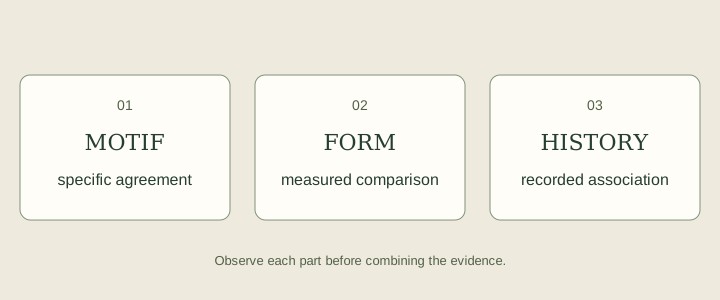
A group is a research question
Begin by recording each jar independently. Only then compare features across the group. This avoids allowing the most convincing object to supply the maker, age or history of all the others. A repeated emblem is a useful lead, but it may represent a shared design convention rather than a single order. Describe the proposed relationship as a hypothesis until evidence supports a stronger statement.
A Sienese example and a carefully worded inference
The Met catalogues a one-handled albarello from Siena, dated about 1510–30, as tin-glazed earthenware, object 46.85.44. Its note identifies an uncommon form shared by about a dozen known examples with the same palette and winged cherub design. The museum suggests a commission for one pharmacy series. The qualification matters: the grouping is an interpretation of converging features, not an invitation to treat any similarly painted jar as part of that series.
Compare several features at once
Make a comparison sheet with one column per jar. Record overall height, width, handle arrangement, rim profile, foot and the placement of ornament. Photograph the same views at a consistent scale. Similar pictures taken at different distances can exaggerate a match or conceal differences in proportion.
Next compare the motif itself. Note its position, orientation and relationship to borders rather than reducing it to a broad label such as “cherub” or “floral.” Two jars can share a subject while organising it differently. A cluster of specific agreements is more informative than one common decorative word.
Distinguish an original series from a later collection
A group assembled by a collector has its own history, even when the pieces were never originally together. Record when and where each entered the collection, retaining receipts and earlier catalogue references. If a seller describes a pharmacy set, ask what connects the pieces beyond their current presentation.
An old photograph or inventory can support an association, but examine whether the objects can actually be identified in it. A general image of pharmacy shelves does not prove that a particular surviving jar was present. Preserve uncertain identifications as uncertain, including any alternatives raised by the evidence.
Display relationships without inventing completeness
A shelf of related jars can illustrate differences as effectively as similarities. Place a small comparison record beside the arrangement and identify it as an assembled group where appropriate. Avoid filling gaps with unlabelled modern pieces and then calling the result complete. A clearly identified reproduction can be useful for explaining scale or arrangement, provided its status remains visible and the historical objects retain their individual records.
| Part or term | What to record | Why it matters |
|---|---|---|
| Shared motif | Specific placement and drawing | A clue rather than proof |
| Shared form | Dimensions and profile | Strengthens or weakens comparison |
| Shared history | Inventories and documented ownership | Tests the proposed association |
Check your understanding
What does repeated decoration provide?
Questions about ceramic apothecary jars
Does matching decoration prove an original pharmacy set?
No. It suggests a relationship that should be tested against form and documentary evidence.
Why preserve the word suggests in a museum account?
It signals the strength and limits of the attribution rather than a fully documented commission.
Can a later assembled group still be worthwhile?
Yes. Record its assembly honestly and keep individual histories separate.
Should a reproduction be used to complete a display?
It can serve an explanatory purpose if clearly labelled, but it does not make an original historical set complete.
Related object guides
Sources and scope
Museum examples are comparisons, not authentication of objects offered elsewhere. The observation record and questions are editorial aids. Research checked 16 October 2026.