Antique Apothecary Jars · research note
Apothecary jars as traded containers: reading heraldry across borders
Apothecary jars can carry evidence of exchange as well as pharmacy use. A painted emblem may refer to a customer or trading connection rather than the workshop that formed the vessel. Distinguishing those roles makes an object history more useful than a nationality inferred from decoration alone.
Syrian jars with an Italian connection
The Aga Khan Museum records two fifteenth-century pharmacy jars, AKM567 and AKM568, from Syria. They are underglaze-painted fritware. The museum connects this group of pharmaceutical containers with trade between the Mamluk world and Italian city-states. It interprets their heraldic shields as most probably associated with Florence and the merchants or commercial centre connected with their cargo. That qualification matters: the interpretation is probable, not an unconditional identification.
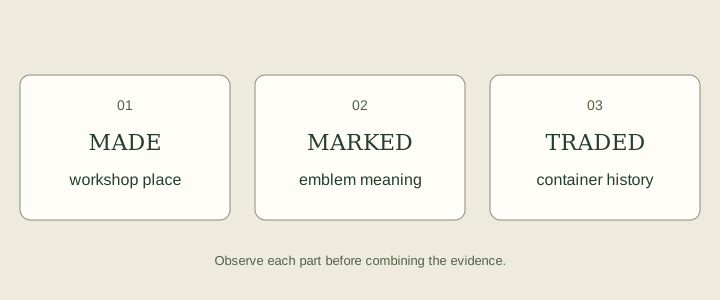
Separate three geographical questions
Ask where the vessel was made, where it was used and which place its decoration invokes. Those answers may differ. A painted shield should first be transcribed as a visual feature, with its shape and surrounding decoration recorded. Only then should it be compared with a documented heraldic identification.
Do not replace a qualified museum attribution with a firmer statement when summarising it. Words such as probably and associated with tell the reader where the evidence ends.
Containers and contents have different histories
A jar can survive after its original contents have disappeared. Its form may support a comparison with pharmaceutical vessels, while a particular drug, merchant or journey remains unknown. Avoid filling those gaps with a plausible story.
Create separate fields for object material, proposed use, inscription and provenance. A later paper label belongs in the record, but should not automatically become evidence of the earliest contents. The same distinction is useful when comparing ceramic apothecary vessels with later glass shop jars.
How to make a comparison useful
Choose a full view that shows the position of the emblem within the decorative scheme, then a detail of the emblem itself. Record the catalogue identifier and the exact degree of certainty used by the source. This allows a future reader to check the comparison without mistaking it for authentication. For an interior display, a label explaining cross-cultural exchange can be more informative than assigning a single national style to every jar.
| Part or term | What to record | Why it matters |
|---|---|---|
| Manufacture | Place supported by the catalogue | Workshop context |
| Emblem | Motif and qualified interpretation | Possible customer connection |
| Use | Evidence for contents or trade | Avoids an invented cargo |
Check your understanding
Must an emblem identify the manufacturing country?
Questions about apothecary jars
Are these examples glass?
No. The museum identifies the pair as fritware.
Is the Florentine connection certain?
The museum uses a probable interpretation, which should be preserved.
Related object guides
Sources and scope
Museum examples are comparisons, not authentication of objects offered elsewhere. The observation record and questions are editorial aids. Research checked 18 October 2026.