Antique Apothecary Jars · research note
Apothecary jars: labels, forms and original contents
Apothecary jars are containers associated with the storage and presentation of medicinal substances. The name encompasses different materials and forms rather than one standard white or blue vessel. Shape, inscription and closure should be examined independently. A decorative label may identify an intended content, but it does not establish what remains inside today. This guide focuses on the evidence that can be recorded without opening or testing unknown residues.
A function can cross material boundaries
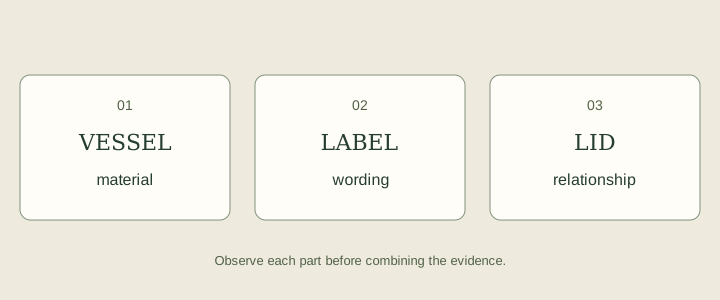
Begin by identifying the visible container: jar or bottle, wide or narrow opening, covered or uncovered, glazed ceramic or glass. Keep that description separate from its proposed pharmacy use. A vessel can acquire a later label, and a familiar pharmaceutical shape can be reproduced for decoration. Neither possibility can be resolved from a styled photograph alone.
The Met catalogues a Dutch apothecary jar made in Delft in 1730–40 as earthenware, object 38.165.24. This documented example shows that the category extends beyond clear glass and French opaline. Its place, period and material are specific to that object. An unmarked white jar should not inherit those details merely because it has a similar outline.
Treat inscriptions as documents
Transcribe the inscription exactly, preserving abbreviations and uncertain letters. Photograph the entire label area and its relationship with the surrounding surface. Record whether the wording appears painted, printed on a separate label or otherwise applied. A Latin-looking word is a research starting point, not an invitation to infer the chemical identity of a surviving deposit.
Separate the history of the label from that of the container. Adhesive edges, overpainting and interrupted decoration may raise questions, but they need careful interpretation. Ask whether a dealer has a catalogue comparison, pharmacy provenance or other documentation. A persuasive story should be traceable to evidence rather than a general association with old medical interiors.
Closures and residues require different questions
Record the lid or stopper in position and note its apparent fit. If it is already separate, photograph its underside and any marks. Do not force a stuck closure or deliberately smell, taste or handle unknown residues. Their identification is a specialist task, and a jar's historical purpose is not evidence that its remaining contents are harmless.
For display, measure the full height including the closure and any projecting handles. Document chips around the opening, cracks and replacement parts. A pharmacy jar used as a modern vase or kitchen container would require a separate assessment; its attractive appearance does not establish cleanliness or suitability. Keep the research record with the object so that later owners understand what has and has not been identified.
| Part or term | What to record | Why it matters |
|---|---|---|
| Container | Material, opening and profile | Object type |
| Inscription | Exact wording and method of application | Documentary research |
| Closure | Fit, marks and condition | Completeness and alterations |
Check your understanding
What can a historical label establish about an unknown residue?
Questions about apothecary jars
Are all apothecary jars made from glass?
No. The category concerns use and includes documented ceramic examples such as the Delft earthenware jar linked here. Record material separately from function. A clear-glass bottle and a tin-glazed jar may belong to related histories without sharing the same manufacture or care needs.
Does a painted label prove original pharmacy use?
An inscription can support research, but its relationship with the vessel needs examination. Record how it is applied and ask for provenance or a documented comparison. Later decorative labelling is a possibility that should not be dismissed simply because the lettering looks old.
Can the label identify a residue safely?
Do not rely on the label to identify remaining material. Contents may have changed, labels may be inaccurate and a container may have been reused. Keep the vessel closed where appropriate and obtain specialist advice instead of sampling or smelling an unknown deposit.
Does a matching lid establish a complete original jar?
A matching appearance and a good fit are useful observations, but they do not alone prove that lid and body were made together. Compare material, marks, decoration and documented history. If the relationship is uncertain, describe the closure as accompanying rather than definitely original.
Related object guides
Sources and scope
Museum examples are comparisons, not authentication of objects offered elsewhere. The observation record and questions are editorial aids. Research checked 16 October 2026.