Vintage Trays · research note
Vintage trays: material, handles and usable surface
A vintage tray is a supporting surface designed to carry or present other objects. Its outline can be decorative, but its rim, underside and handles explain more about construction and condition. Trays appear in many materials, so a floral scene or a metallic colour cannot identify the substrate. Start by recording what the tray is made from, how its parts join and what its history actually supports.
Tray describes a function across materials
Separate the name of the object from the material description. A ceramic tray, a painted metal tray and a wooden tray can serve similar presentation roles while requiring very different handling. A painted design is a decorative treatment, not proof that the support beneath it is metal. Look at already exposed edges and the underside without removing finish.
The Met records an 1836 Sèvres tray made from hard-paste porcelain with enamel decoration and gold. It formed part of a service whose scenes concern cacao cultivation and chocolate preparation. This particular example demonstrates why a tray should be understood within its material and service context. It does not make every decorated rectangular serving piece porcelain or royal manufacture.
Measure the surface and the projections
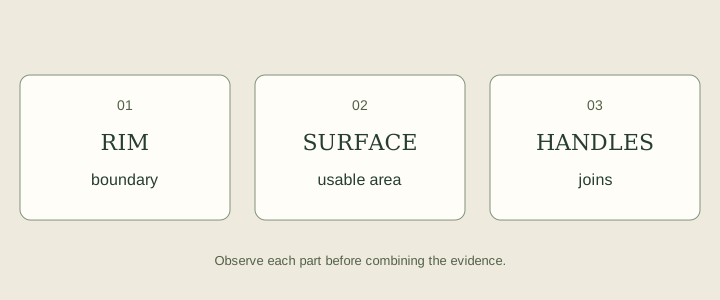
Record the outside width and depth, including handles. Then measure the usable flat area separately. A wide raised border can leave considerably less room for cups than the overall dimensions suggest. Photograph the tray from the side to show rim height, feet and any distortion that a top view conceals.
Identify whether handles are integral, applied or formed as openings in the body. Inspect their junctions without loading them. A loose handle or crack at a pierced opening is a structural concern; wear to a painted motif is a separate surface issue. Do not judge carrying capacity from the apparent thickness of a rim or from how the tray is styled in a listing.
Use condition language that identifies the problem
A useful description locates scratches, losses, cracks and repairs. On painted material, distinguish visible missing decoration from corrosion or substrate damage when the difference can actually be observed. If it cannot, ask for closer photographs and keep the uncertainty explicit. Avoid treating every dark mark as patina or every glossy area as original varnish.
For display, check the support arrangement rather than attaching a hanger through the tray. For practical serving, assess the handles, base and contact surface according to the actual material and condition. Keep restoration records and images of any marks with the object. An attractive tray with unknown construction can still be studied and displayed without promising a load-bearing use that has not been established.
| Part or term | What to record | Why it matters |
|---|---|---|
| Outside outline | Includes handles and rim | Storage and wall-space planning |
| Usable surface | Flat area inside the border | Arrangement of objects |
| Underside | Feet, fixings and marks | Construction and stability |
Check your understanding
Which measurement describes space available for cups?
Questions about vintage tray
Is every floral tray a tole tray?
No. Floral decoration can occur on different supports, including porcelain, wood and metal. Identify or qualify the material separately from the painted subject. A decorative pattern should not supply a technical material label that has not been established from the object.
Why measure inside the rim?
Overall dimensions include borders and projections that may not provide usable serving space. Recording the flat interior area helps explain how cups or other objects could be arranged. Keep that measurement separate from the full width needed for storage or display.
Do handles prove that a tray can still carry weight?
Handles show the intended arrangement, but their present attachment and condition need assessment. A repair or crack may compromise that relationship. Ask about the specific joins and avoid testing an uncertain collectible by loading it with breakable or hot objects.
Can a tray be part of a larger service?
Yes, and documented services can help explain its proportions and decoration. Research the specific pattern or marks before claiming a match. A tray that visually complements cups is not necessarily their original companion; keep an assembled grouping distinct from a documented service.
Related object guides
Sources and scope
Museum examples are comparisons, not authentication of objects offered elsewhere. The observation record and questions are editorial aids. Research checked 16 October 2026.