Serving Pieces · identification & value
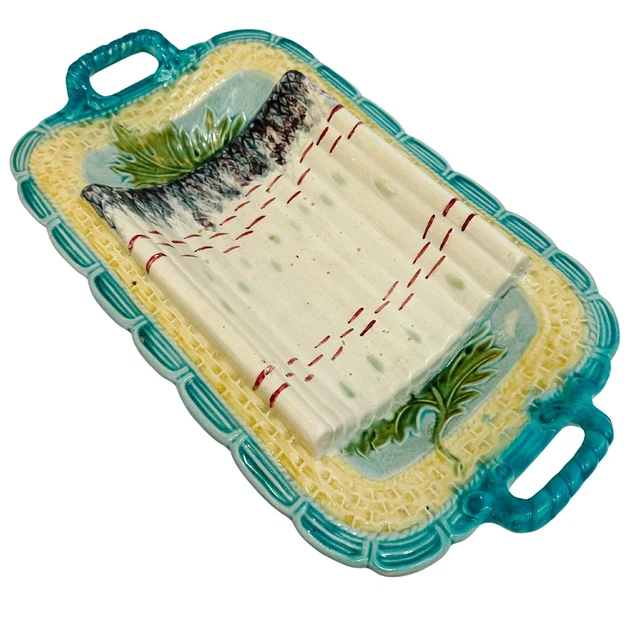
Vintage Serving Platter
A French Sunday lunch ended with the roast on a long oval platter, and in Brittany and Normandy fish platters were sized for the whole fish. Faience platters were for the table; pewter ones hung on the dresser.
1750–1950
Typical asking price on live listings
about $68
Median of current eBay asking prices (via PicClick); listings run from $15 to $895. Asking prices are not sold prices.
Expert tip
For pewter, look for the touch marks on the back: a crowned mark with 'étain fin' or a pewterer's name indicates old French pewter; '95%' or 'étain pur' stamps mean modern lead-free pewter.
History
- Faience fine platters from Creil-Montereau and Sarreguemines were made from the early 19th century.
- Pewter platters were common in French households from the 17th to 19th centuries.
Where it comes from
Gien, Sarreguemines and Creil-Montereau for earthenware platters; Moustiers and Marseille for faience; Lyon and Paris pewterers for étain.
Details to look at
- Shape: oval roast platters, round plats, long narrow fish platters (plats à poisson) up to 60 cm.
- Decoration: transfer-printed views, hand-painted borders, or the moulded rim on plain pewter.
- Marks on the back: impressed 'Gien', 'Sarreguemines' or 'Creil et Montereau', or pewter touch marks.
The market: most wanted
- 18th-century Moustiers faience platters with grotesque or Bérain decoration.
- Large Gien platters with the Renaissance or 'Rouen' patterns.
- Heavy 18th-century French pewter platters with legible touch marks.
Authenticity: period piece or reproduction?
- Old pewter is dull grey, soft, with knife cuts and a slightly dished centre.
- Faience shows crazing and small glaze chips on the rim, with the reddish or buff body showing.
- Printed marks sit under the glaze, not on top of it.
- Warning signs: modern pewter cast thin and bright, transfer-printed 'hand-painted' faience and new platters stained in tea.
Where to buy
- Brocantes, Leboncoin and L'Isle-sur-la-Sorgue.
- In the US and UK, Etsy, eBay and Chairish.
Buyer's checklist
- Marks
- Chips
- Crazing
- Weight
Facts
- Typical size
- L 30–60 cm · W 20–40 cm
- Weight
- 800 g–4 kg
- Period
- 1750–1950
- Materials
- Faience, earthenware, pewter, porcelain
- US search interest
- 190 searches a month
Collector interest
Search demand for serving platter reaches 190 US searches a month across 10 distinct queries.
The styles people attach to it most are farmhouse (10).
Most-searched materials: pewter (40), glass (10).
Related in Serving Pieces
- Antique Salt Cellar
- Vintage Gravy Boat
- Covered Dishes: Butter & Casserole
- Vintage Butter Dish
- Serving Pieces with Lids
- Vintage Platter
- Vintage Soup Tureen
- Vintage Serving Tray
Go deeper: research notes
The Vintage Trays: An Identification Guide gathers 11 sourced object studies, including:
- The tray as a miniature piazza: Michael Graves and Alessi
- A small Strasbourg tray for a covered bouillon cup
- Dry-lacquer trays: cloth beneath a polished surface
See also: Vintage Soup Tureens.