Porcelain & Faience · identification & value
Vintage Oyster Plate
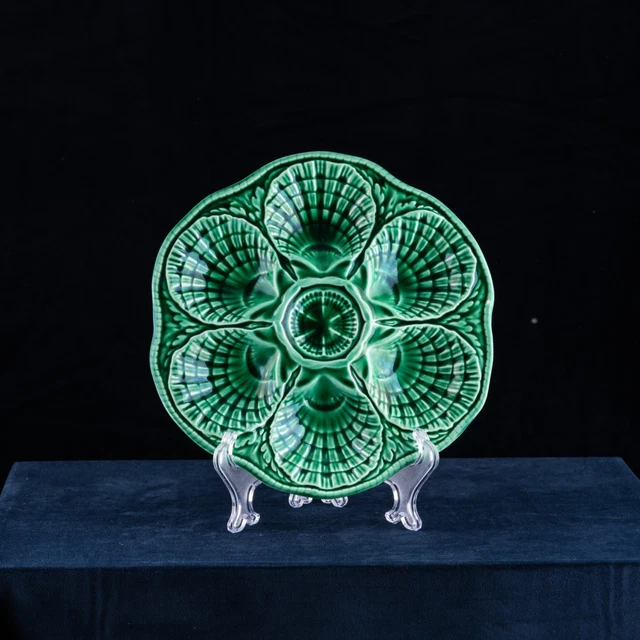
Oysters were a Parisian passion in the 19th century, and railways brought them fresh from Marennes and Cancale to city tables. The dinner service followed: plates with six or twelve shell-shaped wells and a hollow for lemon, so each shell sat steady on ice.
1860–1960
Guide price (US$)
$40 – $150 – $800
low · typical · high, dealer level
Price tip: under $40 is a bargain worth checking twice; above $800, ask for provenance or a maker's mark.
Verified market data (US$)
$77 – $638 – $1,166
lowest · median · highest observed
French dealers asking on Proantic: €70–1 060 (median €580, 12 listings). (Proantic prices converted to USD at 1 EUR = $1.10.)
On eBay (via PicClick), 89 listings for “french oyster plate” asked $9.99 to $650, median $165; median 8 watchers per listing.
Expert tip
Buy them in sixes: single plates are easy to find, but a matched set of six or twelve sells for much more.
History
- French faience factories such as Longchamp, Sarreguemines, Gien and Fives-Lille made majolica oyster plates from about 1860, while Limoges porcelain houses, Haviland among them, made finer versions.
- Mid-century Vallauris potters revived the form in bold colours in the 1950s.
Where it comes from
Longchamp (Burgundy), Sarreguemines (Lorraine), Gien (Loire), Fives-Lille (Nord) and Limoges.
What sets the price
Maker, majolica colors, number of wells, sets.
Details to look at
- Turn the plate: factory marks date it and decide most of the price.
- Count the wells and look at the colours; pink, turquoise and rare glazes sell best, and full sets of twelve are worth more than singles.
- Crazing is normal; chips on the well rims are not.
The market: most wanted
- Longchamp and Sarreguemines majolica plates in rare colours.
- Haviland Limoges oyster plates.
- Complete sets of twelve.
Authenticity: period piece or reproduction?
- Factory marks on the base.
- Crazing consistent with age.
- Hand-painted details.
- Warning signs: modern marks, too-perfect glaze and new reproductions.
Where to buy
- French brocantes and Catawiki for single plates at €20–80; 1stDibs dealers ask $150–600 for 19th-century majolica.
- On eBay, 89 'French oyster plate' listings had a median ask of $165 and up to 111 watchers on the best pieces.
Buyer's checklist
- Factory mark
- Chips on well rims
- Colour and number of wells
- Matching set
Facts
- Typical size
- Ø 22–26 cm, 6 or 12 wells
- Weight
- 0.4–0.7 kg each
- Period
- 1860–1960
- Materials
- Majolica (barbotine), faience, hard-paste porcelain
- US search interest
- 6,090 searches a month
Collector interest
US shoppers type 6,090 searches a month about oyster plate, spread over 85 keyword variants.
The materials buyers name are porcelain (20), ceramic (20), glass (10).
Searches by country of origin: french (120).
Related in Porcelain & Faience
- Antique French Plates
- Vintage Dish
- Limoges Porcelain
- Vintage Limoges China
- Vintage Ironstone China
- Vintage Dinnerware
- Antique Haviland China
- Antique China
Go deeper: research notes
The Vintage Oyster Plates: An Identification Guide gathers 11 sourced object studies, including: