Porcelain & Faience · identification & value
Vintage Dinnerware
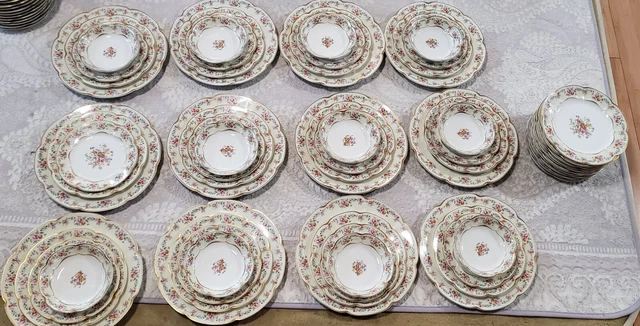
From the 19th century the French dining table changed with industry: factories in Lorraine, the Loire and Limoges produced complete services, from white porcelain with gilt rims to transfer-printed faience showing hunting scenes and fables. Every family had a service for every day and one for Sunday.
1830–1960
Expert tip
Turn a plate over: a French piece carries an underglaze back stamp (Gien, Sarreguemines, HB Quimper, Limoges), and old plates show grey wear marks on the foot ring from decades of stacking.
History
- Limoges became France's leading porcelain centre in the 19th century, with firms such as Haviland and Bernardaud.
- Faience factories at Gien, Sarreguemines, Lunéville and Quimper produced dinnerware in transfer-printed and hand-painted patterns from the 19th century.
Where it comes from
Limoges for porcelain; Gien (Loiret), Sarreguemines and Lunéville (Lorraine), Quimper (Brittany), Digoin and Longchamp for faience and earthenware; Vallauris and Dieulefit for Provençal pottery.
Details to look at
- Back stamps and pattern names.
- Decoration: hand-painted, transfer-printed or gilded.
- Body: porcelain (translucent) or faience (opaque, lighter).
The market: most wanted
- Complete Limoges porcelain services in gilt patterns.
- Hand-painted Quimper faience by HB and Henriot.
- Gien and Sarreguemines services with transfer prints.
Authenticity: period piece or reproduction?
- Underglaze stamps that match the period's known marks.
- Crazing on faience and wear on gilt rims.
- Sizes and shapes of pieces should match period services.
- Warning signs: modern reproductions with new back stamps, chips filled with resin, and printed decoration passed off as hand painting.
Where to buy
- Regional brocantes, Leboncoin and L'Isle-sur-la-Sorgue for faience services; Drouot and Catawiki for complete Limoges sets.
- In the US and UK, Replacements Ltd, eBay and Etsy for individual pieces; Chairish for complete services.
Buyer's checklist
- Chips and cracks
- Set completeness
- Back stamps
- Gilding wear
Facts
- Typical size
- Plates Ø 20–28 cm · Serving dishes L 30–45 cm
- Weight
- Plate 300–700 g · Service of 40 pieces 15–30 kg
- Period
- 1830–1960
- Materials
- Porcelain, faience, earthenware, gilding
- US search interest
- 2,730 searches a month
Collector interest
Dinnerware draws 2,730 monthly US searches, split into 54 keyword variants.
The styles people attach to it most are french country (210), art deco (120), chinoiserie (50), shabby chic (30).
The materials buyers name are stoneware (360), crystal (210), porcelain (170), glass (60).
Related in Porcelain & Faience
- Antique French Plates
- Vintage Oyster Plate
- Vintage Dish
- Limoges Porcelain
- Vintage Limoges China
- Vintage Ironstone China
- Antique Haviland China
- Antique China
Go deeper: research notes
The Vintage Oyster Plates: An Identification Guide gathers 11 sourced object studies, including: