Coffee & Tea · identification & value
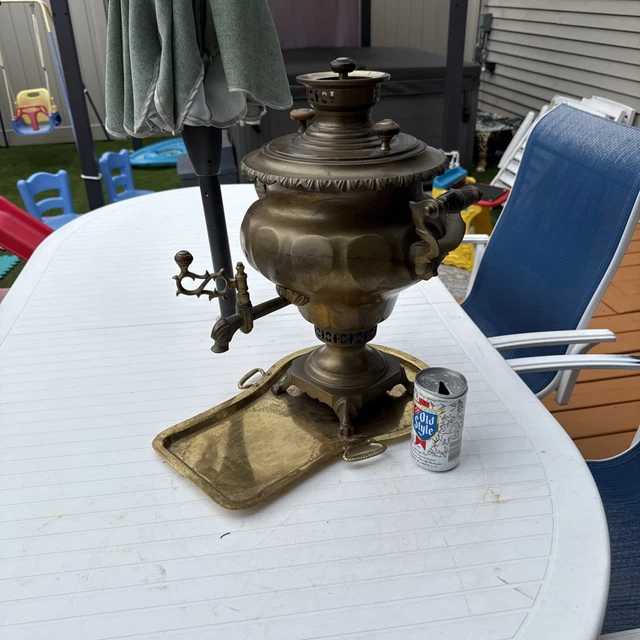
Antique Samovar
In the Russian Empire the samovar was the heart of the house: charcoal burned in a central tube, the water around it boiled, and a teapot of concentrated tea warmed on the crown. By 1900 Tula factories made hundreds of thousands a year, and the samovar travelled with émigrés to Paris after 1917.
1780–1930
Verified market data (US$)
$110 – $825 – $24,750
lowest · median · highest observed
French dealers asking on Proantic: €100–22 500 (median €750, 59 listings). (Proantic prices converted to USD at 1 EUR = $1.10.)
Expert tip
Read the stamps near the top of the body: Tula samovars carry the maker's name in Cyrillic and rows of stamped exhibition medals; count the medals and compare with the maker's known award list to date the piece.
History
- Samovar production in Tula grew from the late 18th century; by the late 19th century it was an industry with family firms such as the Batashevs.
- After 1917 production continued in Soviet factories; electric samovars appeared in the 20th century.
Where it comes from
Not French: the samovar is Russian, and its capital is Tula, south of Moscow, home to dozens of makers in the 19th century (the Batashev family, Shemarin and many others); later examples come from Iran, Turkey and Central Asia.
Details to look at
- The maker's stamps and medal impressions on the body.
- The internal chimney (charcoal tube) and grate.
- The tap, handles and crown in brass or nickel-plated brass.
The market: most wanted
- Tula samovars by the Batashev family and other medal-stamped makers.
- Silver and silver-plated samovars from Russian silversmiths.
- Unusual shapes (vase, barrel, egg) from 19th-century makers.
Authenticity: period piece or reproduction?
- Period samovars are hammered or spun brass or copper, with soldered and riveted seams.
- The interior shows mineral scale and the chimney shows burn marks.
- Stamps are struck, not cast, and correspond to real makers.
- Warning signs: very light brass, electric elements fitted into old bodies without disclosure, and new 'imperial' eagle stamps.
Where to buy
- Saint-Ouen and Drouot sales of Russian art; Leboncoin, given the long Russian presence in France.
- In the US and UK, eBay, Etsy and specialist Russian antiques dealers; check the tap for leaks before using.
Buyer's checklist
- Maker's stamps
- Chimney condition
- Leaks at tap
- Handles and crown
Facts
- Typical size
- H 35–60 cm · Ø 20–35 cm
- Weight
- 4–10 kg
- Period
- 1780–1930
- Materials
- Brass, copper, nickel-plated brass, silver plate
- US search interest
- 150 searches a month
Collector interest
US shoppers type 150 searches a month about samovar, spread over 9 keyword variants.
The materials buyers name are silver (30), copper (10).
Searcher intent: 7% ask what it is worth.