Coffee & Tea · identification & value
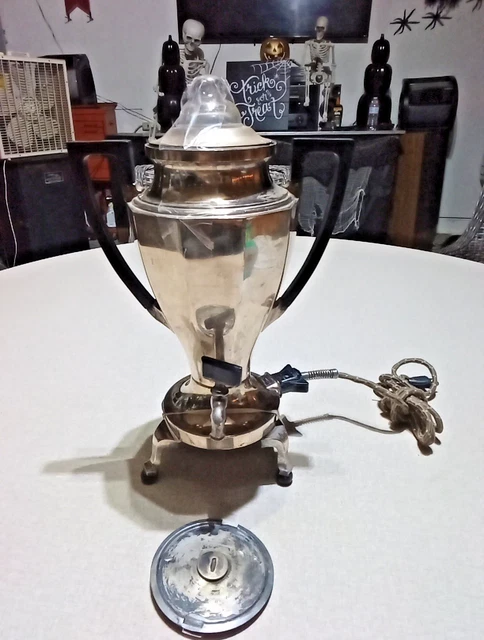
Vintage Percolator
Every morning in mid-century America, the sound of a percolator bubbling on the stove meant coffee was nearly ready, as water rose through the stem and splashed over the grounds, visible through the glass knob in the lid. Aluminium made the pots cheap and light, and they went camping, to the church supper and into every kitchen.
1900–1970
Typical asking price on live listings
about $49
Median of current eBay asking prices (via PicClick); listings run from $2.5 to $3,000. Asking prices are not sold prices.
Expert tip
Open the lid and check that all the inner parts are there: the pump stem, the basket and the spreader cover, plus the glass knob on top; missing pieces are hard to find and make the pot purely decorative.
History
- The modern stovetop percolator was patented by Hanson Goodrich in the US in 1889.
- Aluminium percolators were mass-produced by Mirro, West Bend and Wear-Ever from the 1920s; electric models became common from the 1950s.
Where it comes from
No single French region: aluminium percolators are mostly American (Mirro of Manitowoc, Wisconsin; West Bend, Wisconsin; Wear-Ever of New Kensington, Pennsylvania). French kitchens used enamelled coffee pots and cafetières from Japy Frères at Beaucourt (Territoire de Belfort) and other eastern enamelware works.
Details to look at
- Parts: stem, basket, spreader, glass knob.
- Body: polished, hammered or coloured anodised aluminium.
- Marks: maker's name and size (cups) stamped on the base.
The market: most wanted
- Hammered-finish and spun aluminium percolators by Mirro and West Bend with original glass knobs.
- 1950s–60s electric percolators in coloured anodised aluminium or with streamlined forms.
- French Japy enamel coffee pots and cafetières in bright or speckled colours.
Authenticity: period piece or reproduction?
- Stamped bases give maker, model or catalogue number and cup size (for example 'Mirro 8 cup'); unmarked pots are harder to place.
- Period handles are black Bakelite or wood, riveted or screwed to a cast bracket, and the glass knob screws in from inside the lid.
- Aluminium that has been through a dishwasher turns chalky and dark grey; good pieces keep a soft polished or satin surface.
- Warning signs: pump stem or basket missing, pitting or holes in the base, cracked or replacement plastic knobs, and electric models with brittle cords.
Where to buy
- Brocantes, vide-greniers and Leboncoin for French enamel coffee pots and Japy pieces.
- In the US, eBay, Etsy, thrift stores and estate sales for aluminium percolators; replacement glass knobs are sold separately on eBay.
Buyer's checklist
- Stem, basket and spreader
- Glass knob
- Interior pitting
- Handle secure
Facts
- Typical size
- H 20–30 cm · Ø 10–15 cm
- Weight
- 0.4–1 kg
- Period
- 1900–1970
- Materials
- Aluminium, enamelled steel, glass, Bakelite, wood
- US search interest
- 280 searches a month
Collector interest
Search demand for percolator reaches 280 US searches a month across 3 distinct queries.