Antique Copper Pots & Pans · research note
Copper chafing dishes: reading the space beneath the vessel
A vintage copper chafing dish belongs to the history of warming and presentation. Its distinctive evidence may lie beneath the bowl, where a support or heat source explains the assembly. Looking only at the polished upper vessel can obscure the difference between a pan and a device intended to support another dish.
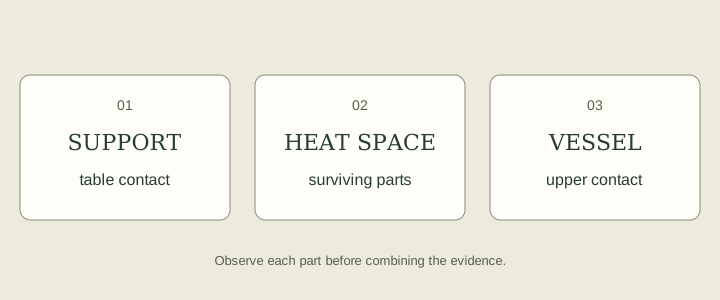
Start with the arrangement, not the shine
Draw a simple vertical section in words: support at the bottom, any space for a heat source, then the vessel or plate above. Record which parts survive and which are merely suggested by an empty socket or ledge. This description is more useful than calling every copper vessel with legs a chafing dish. The identification should explain how the visible parts relate to one another.
A documented early form
The Met’s chafing dish by Peter Van Dyck, made in New York around 1725, is silver rather than copper. Its catalogue describes a pierced bowl, a removable grate, three projections supporting a plate or bowl, and a wooden handle. The museum explains that this eighteenth-century form used hot coals and that chafing dishes were more commonly made in copper, brass, iron or pewter than silver. The example provides a documented structural comparison; it does not establish the age or fuel of every later warming apparatus.
Separate a warming support from a food container
In a comparison photograph, identify the surface intended to carry a separate dish. A pierced bowl cannot be interpreted in the same way as an ordinary liquid-holding saucepan. Conversely, a solid removable vessel may belong above a separate support. Photograph the assembly both together and, only where parts lift freely, apart. Do not unscrew fittings simply to make the arrangement more legible.
An incomplete object can still be described accurately. “Support with upper vessel missing” says more than a confident functional label that conceals the gap. A loose burner placed inside by a previous owner is an association to investigate, not proof of the original design.
Why material and function need separate records
The copper colour of a body does not identify every component. Record handles, legs, fastenings and inserts independently, using the seller’s material description only when its basis is clear. A replacement vessel can fit an older support without belonging to its original manufacture. Dimensions should include the opening that receives the upper part, not just overall height.
For comparison, make a small diagram of contact points: where the bowl rests, where the feet meet the table and where a removable component is retained. This describes the assembly without claiming that it is structurally sound or suitable for renewed heating.
Explain historical operation without reenacting it
A display caption can describe the documented heating arrangement and identify missing elements. Historical use with coals is not a recommendation to light an antique on a modern table. For a decorative kitchen setting, present the complete outline with its components clearly labelled. Any proposed working use requires an assessment of that particular object, rather than an assumption based on another museum example.
| Part or term | What to record | Why it matters |
|---|---|---|
| Lower space | Grate, opening or support | Explains the heating arrangement |
| Upper contact | Rests for a vessel or plate | Distinguishes support from container |
| Loose component | Fit and documented association | May be a later addition |
Check your understanding
Which detail helps identify a warming assembly?
Questions about vintage copper chafing dish
Is a chafing dish simply a saucepan?
Not necessarily. The warming arrangement can include a support for a separate dish.
Did every chafing dish use coals?
No universal fuel can be inferred from the name. The Met example documents one early form.
Does a fitting burner prove completeness?
No. Fit alone does not prove that parts were originally supplied together.
What should a seller photograph?
The complete assembly, the space beneath the vessel and any freely removable parts, including their contact points.
Related object guides
Sources and scope
Museum examples are comparisons, not authentication of objects offered elsewhere. The observation record and questions are editorial aids. Research checked 16 October 2026.