Copper & Cookware · identification & value
Antique Kettle
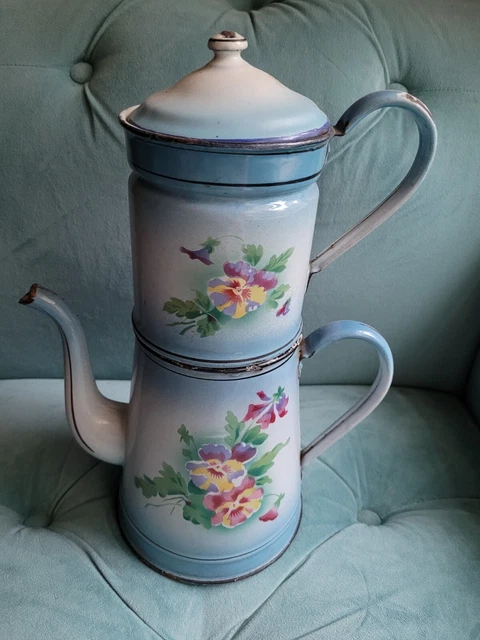
Before the gas stove, a kettle sat at the edge of the hearth or on the iron range all day, keeping water hot for coffee, washing and cooking. Coppersmiths raised them from sheet copper with hammers and joined the seams with interlocking teeth. Later, enamelled cast-iron kettles in bright colours came from the foundries of northern France and stood on the cooker in many farmhouses.
1750–1950
Guide price (US$)
$30 – $120 – $600
low · typical · high, dealer level
Price tip: under $30 is a bargain worth checking twice; above $600, ask for provenance or a maker's mark.
On eBay (via PicClick), 67 listings for “antique french copper kettle” median asking price $140; median 3 watchers per listing.
Expert tip
Look at the seam on the side and bottom of a copper kettle: a zigzag dovetail seam (copper teeth interlocked and brazed) means it was hand-made, usually before the 1870s; a smooth spun body means machine production.
History
- Hand-made copper kettles with dovetailed seams date mostly from the 18th and early 19th centuries.
- Spun copper kettles were made industrially from the second half of the 19th century.
- Enamelled cast-iron and steel kettles became common in French kitchens in the early 20th century.
Where it comes from
Villedieu-les-Poêles in Normandy and other provincial coppersmiths for hand-made copper kettles (bouilloires); the cast-iron foundries of northern France, including Godin in Guise, for enamelled iron kettles; England and the Netherlands also made many of the copper kettles found today.
What sets the price
Material, size.
Details to look at
- The seams on the side and base: dovetailed and brazed, riveted, or seamless spun.
- The handle: fixed or swinging, forged iron, cast brass or turned wood, and how it is riveted.
- The spout, soldered or riveted on, and how the lid sits with its knob.
The market: most wanted
- 18th- and early 19th-century hand-made copper kettles with dovetailed seams.
- Large copper kettles from Normandy and the southwest with iron swing handles.
- Enamelled cast-iron kettles by known French foundries in original colours.
Authenticity: period piece or reproduction?
- Hand-made copper has hammer marks and slight irregularities in shape when seen from above.
- Old tinning inside may be worn, scaled or blackened; a kettle used for decades often has limescale too.
- Iron handles are hand-forged with irregular thickness; rivets are domed and slightly uneven.
- Warning signs: thin, light copper, a lacquered bright finish, cast-brass decorative handles, and stamped 'antique' patterns.
Where to buy
- In France, regional brocantes in Normandy and Brittany, L'Isle-sur-la-Sorgue for fine copper, Leboncoin for enamelled kettles, and the copper shops of Villedieu-les-Poêles.
- In the US and UK, Etsy, eBay and specialist copper dealers; UK country fairs for English copper kettles. The guide range is $30–600.
Buyer's checklist
- Seams tight
- Leaks
- Handle secure
- Lining
Facts
- Typical size
- H 20–35 cm · Ø 15–30 cm
- Weight
- 1–4 kg
- Period
- 1750–1950
- Materials
- Copper, tin, brass, iron, cast iron, enamel
- US search interest
- 6,880 searches a month
Collector interest
Kettle draws 6,880 monthly US searches, split into 76 keyword variants.
The styles people attach to it most are retro (80), art deco (20), farmhouse (20), victorian (10).
The materials buyers name are copper (5,070), cast iron (1,520), brass (10), metal (10).
Related in Copper & Cookware
- Copper Cup
- Copper Pot
- Vintage Tea Kettle
- Copper Pots & Pans
- French Copper Cookware
- Vintage Terracotta Pots
- Terracotta Plant Pots
- Vintage Flower Pots
Go deeper: research notes
The Antique Copper Pots & Pans: An Identification Guide gathers 11 sourced object studies, including: