Antique Butter Moulds · research note
Barrel butter churns: the rotating vessel, window and maker’s mark
A wooden butter churn mounted on a stand is a machine as well as a vessel. Its handle, pivots and closure explain which part moved, while a window or maker’s inscription may provide more specific evidence. Studying these details gives a barrel churn a place in dairy history beyond its familiar rustic silhouette.
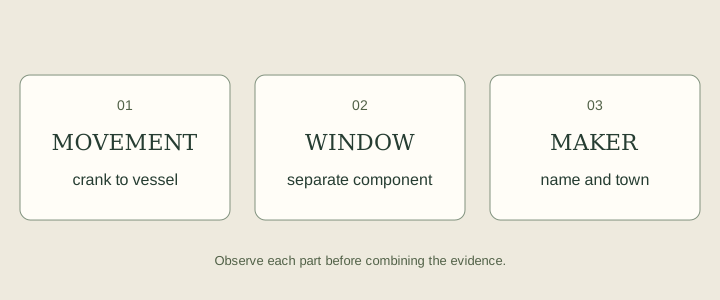
Find the moving part
The first question is whether the handle turns the container itself or operates something inside a stationary vessel. Do not answer from the presence of a crank alone. Follow the visible connection between handle, shaft, vessel and supporting frame. A photograph of each side is particularly useful because one view may conceal the pivot opposite the handle.
For a barrel mounted between supports, record the axis about which the vessel was intended to rotate. This is a description of the arrangement, not a recommendation to turn an old mechanism. Missing fittings, loose supports or resistance can prevent safe movement even when the original operating principle is clear.
A documented rotating churn from Haverfordwest
The National Trust records a churn made by G. Llewellin & Son of Haverfordwest in the Penrhyn Castle collection, NT 1700762. Its oak barrel is carried on a double A-frame made of pine. The catalogue describes a crank, shaft fittings, a hinged lid secured by a brass clamp and a circular glass aperture for viewing the interior. The listed materials also include iron, steel and brass: “wooden” does not describe the whole assembly.
The record leaves the date unknown despite naming the maker and town. This is a useful example of how a precise manufacturer attribution can coexist with an unresolved production date. It is a Welsh comparison, not evidence of French manufacture for an unmarked churn found in France.
The window is a component with its own condition
A glazed opening should be recorded separately from the surrounding wooden lid. Note its shape, retaining surround and visible condition without attempting to remove it. The window can help explain the viewing arrangement, but a missing pane does not establish whether the rest of the lid is original. Describe the gap and surviving fittings rather than inventing a replacement specification.
A second National Trust record, NT 959341 at Nostell Priory, identifies a nineteenth-century wooden churn by W. Waide and Sons of Leeds. It also notes a small glass window in the fitted lid. This gives another documented example of the feature; it does not turn the window into a universal dating rule for wooden churns.
Transcribe before researching the maker
Record the inscription exactly, keeping a maker’s name, town, model wording and size field distinct. Photograph the lettering in its setting as well as close up. If a size field is empty or illegible, say so; do not borrow a number from a similar example. Marketing language on a plate should remain a transcription until independent evidence explains what it refers to.
A maker’s name can guide a search for catalogues, but an apparent resemblance is only a starting point. Compare the support shape, lid arrangement and crank connection with the illustrated model. An old advertisement dates the availability of that design, while the date of an individual surviving machine may remain uncertain.
Place the machine in a dairy display
A churn and a small butter stamp can illustrate different stages of work, provided they are labelled individually. The National Trust’s sycamore stamp NT 547815 has an outer cover and a geometric impression face. Its catalogue suggests domestic use rather than treating all decorated butter tools as commercial equipment. A stamp of this kind offers a useful contrast in scale and purpose to a rotating vessel.
If you assemble such objects for a French country interior, describe the grouping as a present-day display. Measure the complete churn, including its frame and projecting handle, before selecting a position. Keep each object’s provenance separate: sharing a dairy theme does not mean the pieces originally worked together or came from the same farm.
| Part or term | What to record | Why it matters |
|---|---|---|
| Crank and shaft | Which part they connect to | Establish the intended movement |
| Window and closure | Pane, surround, hinge and clamp | Record distinct components |
| Maker’s inscription | Name, town and model or size fields | Keep attribution separate from dating |
Check your understanding
What best establishes what the handle turns?
Questions about wooden butter churn
Does a hand crank always rotate the barrel?
No. Trace the actual connection: a handle may operate a mechanism inside a stationary container.
Can a manufacturer be known while the date remains unknown?
Yes. The National Trust’s G. Llewellin & Son example explicitly separates the maker attribution from its unknown date.
Does a glass window identify a nineteenth-century churn?
Not by itself. A documented example establishes the feature on that object, not a universal date for every similar churn.
Are a churn and stamp displayed together an original dairy set?
Only if evidence connects them. Otherwise describe them as an assembled group and retain separate histories.
Related object guides
Sources and scope
- National Trust Collections: G. Llewellin & Son butter churn, NT 1700762
- National Trust Collections: W. Waide and Sons butter churn, NT 959341
- National Trust Collections: sycamore butter stamp, NT 547815
Museum examples are comparisons, not authentication of objects offered elsewhere. The observation record and questions are editorial aids. Research checked 16 October 2026.