Machines & Office · identification & value
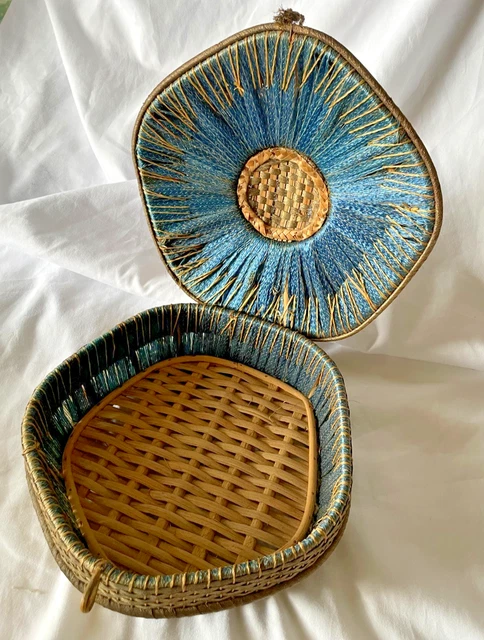
Vintage Sewing Basket
In a 19th-century French salon, the lady of the house kept her needlework in a travailleuse, a small table on slender legs with a lifting lid and a fitted tray of compartments for thimbles, spools and scissors. In the United States, from the 1920s onward, sailors and travellers brought home round Chinese sewing baskets with coins and beaded tassels, which became household staples.
1840–1960
Typical asking price on live listings
about $90
Median of current eBay asking prices (via PicClick); listings run from $2.5 to $3,000. Asking prices are not sold prices.
Expert tip
On a Chinese sewing basket, look at the decoration on the lid: originals usually have old Chinese coins, glass beads and carved tassels tied with silk cord; examine the inside for a lining of old paper or silk and the bamboo or rattan weave for natural ageing.
History
- The French travailleuse was especially popular under Louis-Philippe and Napoleon III, often in rosewood, mahogany or blackened wood with inlay.
- Chinese sewing baskets, sometimes called 'Nanking baskets', were exported in quantity from the 1920s to the 1950s.
Where it comes from
Two separate traditions: the French travailleuse (sewing table) and wicker panier à ouvrage from French cabinetmakers and basket villages such as Fayl-Billot (Haute-Marne) and Vallabrègues (Gard); and the Chinese 'Nanking' sewing baskets, made in China and sold widely in the US in the early to mid-20th century.
Details to look at
- Inside the travailleuse: a lift-out tray divided into lidded compartments, often lined in silk or paper, with a well below for work in progress.
- On Chinese baskets: lid ornaments of coins, glass or carved stone rings and beads, plus silk tassels and knotted cord.
- The weave and frame: split bamboo, rattan or wicker, and lacquer that has mellowed to amber.
The market: most wanted
- Napoleon III and Louis-Philippe travailleuses in rosewood or blackened wood with brass or mother-of-pearl inlay and complete fittings.
- Chinese baskets with old coins, carved rings and intact tassels, especially in graduated nesting sets.
- French wicker sewing baskets on legs, with original lining and interior pockets.
Authenticity: period piece or reproduction?
- Old Chinese cash coins have softened inscriptions, a worn square hole and dark patina; new coins are sharp and yellow.
- Old silk tassels fade unevenly and fray; synthetic tassels stay glossy and uniform.
- A travailleuse's tray and lid are made from the same wood as the case, with matching patina and old hinges.
- Warning signs: baskets with plastic beads and glued-on modern coins, travailleuses converted from other small tables, and missing trays replaced in plywood.
Where to buy
- In France: Leboncoin and Selency for travailleuses and wicker baskets, Drouot and regional auctions for marquetry pieces, Puces de Vanves for sewing accessories.
- In the US and UK: eBay, Etsy and estate sales for Chinese sewing baskets; antique malls and Chairish for sewing tables and stands.
Buyer's checklist
- Contents and tray
- Lid hinge
- Tassels complete
- Wood condition
Facts
- Typical size
- Basket Ø 20–30 cm · H 12–20 cm; travailleuse H 70–75 cm
- Weight
- Basket 0.3–1 kg; travailleuse 8–15 kg
- Period
- 1840–1960
- Materials
- Rosewood, mahogany, wicker, bamboo, rattan, silk, glass beads, coins
- US search interest
- 660 searches a month
Collector interest
US shoppers type 660 searches a month about sewing basket, spread over 8 keyword variants.
Searches by country of origin: chinese (170).