Machines & Office · identification & value
Art Deco Radio
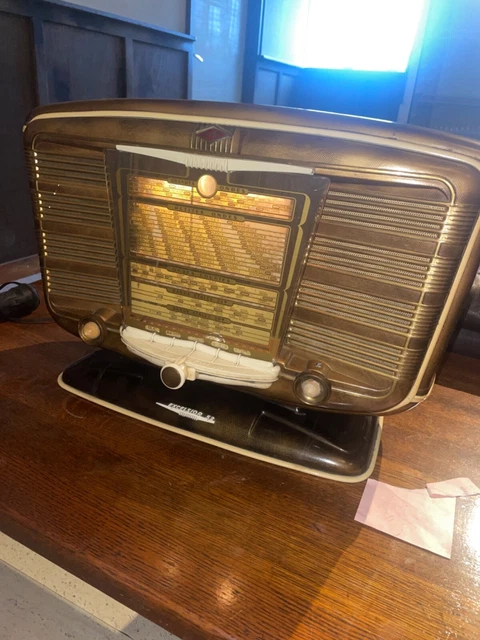
In 1930s France the 'poste de TSF' was the newest piece of furniture in the salon, and families gathered around it for the evening news and music. Designers treated it like a cabinet: burr walnut, ebonised stripes, chrome grilles, or the new moulded plastics that let a radio look like a small building.
1928–1950
Guide price (US$)
$40 – $200 – $1,500
low · typical · high, dealer level
Price tip: under $40 is a bargain worth checking twice; above $1,500, ask for provenance or a maker's mark.
Expert tip
Never plug in an untested set: ask whether the capacitors have been replaced, and look at the back for a paper label with the model number, which is what you need to price and restore it.
History
- French radio (TSF, télégraphie sans fil) became a mass product in the late 1920s, with Paris-area makers such as Ducretet-Thomson and Radiola alongside Philips.
- American Catalin radios of the late 1930s and 1940s, and Walter Dorwin Teague's mirrored-glass Sparton 'Nocturne' of 1935, are the icons of Art Deco radio collecting.
Where it comes from
Paris and its suburbs for French TSF sets (Ducretet-Thomson, Radiola, Philips's French factory at Suresnes); the most collected Art Deco radios are also Dutch (Philips) and American (Catalin and Bakelite sets by Fada, Emerson, Sparton).
What sets the price
Cabinet, working.
Details to look at
- Cabinet: veneered wood, Bakelite, or cast Catalin in marbled colours.
- Grille cloth and fretwork, original or rewoven.
- Dial glass with station names, knobs matching the model.
The market: most wanted
- Catalin radios in rare colour combinations without cracks.
- Sparton 'Nocturne' and 'Bluebird' mirrored designs.
- French TSF sets with streamlined veneer cabinets and original dials.
Authenticity: period piece or reproduction?
- Original Catalin shrinks slightly and its colours mellow (white turns butterscotch); cracks start at the corners.
- Period sets have valve sockets, cloth-covered wiring and a chassis label.
- Bakelite smells of phenol (carbolic) when rubbed warm.
- Warning signs: a modern Bluetooth board in an empty cabinet sold as 'working', repainted Bakelite, and resin copies of Catalin colours.
Where to buy
- Saint-Ouen, Leboncoin and radio swap meets (bourses TSF) for French sets; the guide range is $40–1500, with average around $200.
- In the US, eBay and specialist radio auctions for Catalin and Sparton; Etsy and Chairish for restored decorative sets.
Buyer's checklist
- Capacitors replaced
- Model label on back
- Cabinet cracks or veneer lifts
- Original knobs and dial
Facts
- Typical size
- H 25–50 cm · W 30–60 cm · D 18–30 cm
- Weight
- 3–12 kg
- Period
- 1928–1950
- Materials
- Wood veneer, Bakelite, Catalin, chrome, glass, valves
- US search interest
- 320 searches a month
Collector interest
US shoppers type 320 searches a month about radio, spread over 23 keyword variants.
The styles people attach to it most are art deco (170).