Clocks · identification & value
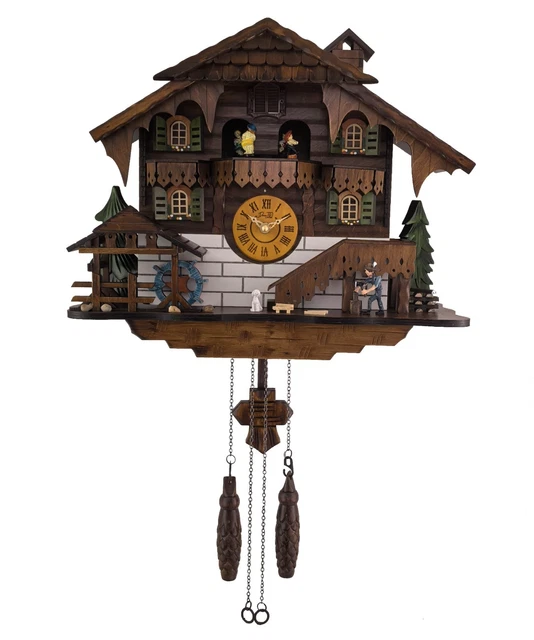
Vintage Cuckoo Clock
In the Black Forest, farmers turned to clockmaking in the long winters, carving cases and selling clocks by peddler across Europe. A bellows and two small pipes gave the clock its call, and by the mid-19th century the carved 'railway house' design had become the familiar cuckoo clock.
1850–1970
Guide price (US$)
$80 – $300 – $2,000
low · typical · high, dealer level
Price tip: under $80 is a bargain worth checking twice; above $2,000, ask for provenance or a maker's mark.
Verified market data (US$)
$2,200 – $2,420 – $2,420
lowest · median · highest observed
French dealers asking on Proantic: €2 000–2 200 (median €2 200, 2 listings). (Proantic prices converted to USD at 1 EUR = $1.10.)
Expert tip
Count the weights and pull back the side door: two weights means time and cuckoo only, three means a music box too; a movement with wooden plates or gears is older than one with stamped brass plates.
History
- Cuckoo clocks were made in the Black Forest from the 18th century; the origins are uncertain, and stories of a single inventor are legend.
- The railway house (Bahnhäusle) case came from a design competition of the Furtwangen clockmaking school, founded in 1850; elaborately carved hunting pieces (Jagdstück) followed in the later 19th century.
Where it comes from
Not French: the cuckoo clock comes from the Black Forest in south-west Germany (Furtwangen, Triberg, Schönwald, Neustadt); France's country clock is the comtoise from the Jura instead.
What sets the price
Carving, maker.
Details to look at
- Carving: leaves, birds, hunting trophies or simple house.
- Movement type: one-day or eight-day.
- Bellows, pipes and the bird mechanism.
The market: most wanted
- Large carved 19th-century hunting clocks.
- Signed clocks by known makers such as Johann Baptist Beha.
- Early railway house clocks with painted fronts.
Authenticity: period piece or reproduction?
- Old movements have wear and hand-finished parts.
- Carving is deep with tool marks.
- Bellows paper or leather may be replaced but should be in period style.
- Warning signs: plastic parts, quartz movements, resin carvings and modern clocks sold as antique.
Where to buy
- Brocantes, Leboncoin and Catawiki in France; German flea markets and dealers in the Black Forest.
- eBay, Etsy and clock dealers in the US and UK. The guide range is $80–2000.
Buyer's checklist
- Movement runs
- Cuckoo sound
- Carving damage
- Weights and pendulum
Facts
- Typical size
- H 25–100 cm · W 20–60 cm
- Weight
- 1–8 kg
- Period
- 1850–1970
- Materials
- Wood (linden, walnut), brass, cast iron weights, paper, leather
- US search interest
- 720 searches a month
Collector interest
US shoppers type 720 searches a month about cuckoo clock, spread over 9 keyword variants.
Searcher intent: 4% want to buy.