Vintage Door Handles · research note
Door handle or French door knocker? Reading the working parts
A French door knocker and a door handle can both present an ornamental ring or sculpted plate. Their function depends on the working arrangement, not simply the outline. A detached fitting is especially easy to misname. Look for the relationship between the moving part, the mounting and the surface it was intended to meet.
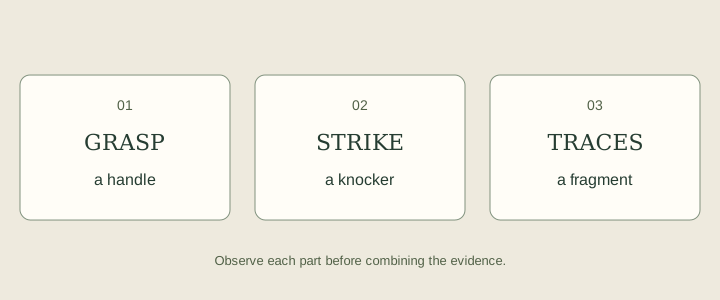
Pulling and striking are different actions
A handle provides a grasping point; a knocker is arranged to strike a surface and announce a visitor. A ring alone does not establish which action was intended. Examine how it pivots, the direction in which it can move and whether a corresponding striking point survives. Some fittings require more context than a detached front view can supply. Use an uncertain description when the evidence is incomplete.
A French museum fragment makes the distinction visible
The Musée Le Secq des Tournelles catalogues a seventeenth-century French knocker plate with a bearded head, made of openwork and engraved iron. Its note identifies traces associated with a missing ring and discusses the place of a striking stud. The surviving plate therefore preserves evidence of an assembly that is no longer complete. The example is a reminder that a decorative face can be one component of a functional device.
Map the contact points
Photograph the front, side and accessible reverse. Mark the locations of pivots, mounting holes and possible contact areas on a copy of the photograph. Keep a mounting hole separate from a striking position: both can interrupt a plate, but they answer different questions. The interpretation should explain how the parts could work together, not merely identify an attractive motif.
Record worn areas without immediately assigning a cause. A smooth patch may relate to use, cleaning or later intervention. Compare it with the proposed movement of the fitting. If the contact pattern and mechanical explanation disagree, that is a reason to investigate further rather than to ignore the awkward detail.
Distinguish a fragment from a complete set
A loose ring, a backplate and a striking stud offered together may form an assembled group rather than an original set. Request information about where they were found and whether they were removed together. Matching colour is not enough to establish association. Record differences in dimensions, attachment positions and construction so that the relationship can be evaluated.
A fragment can remain an interesting example of metalwork. Its description should explain what survives and what is missing. Calling it a plate from a knocker is more useful than presenting it as a complete working knocker when the moving element is absent.
Keep installation separate from identification
For a proposed return to a door, the fitting and the door must both be assessed. Existing holes, door thickness and required clearances are practical constraints, but they do not resolve historical attribution. Avoid modifying an old fitting just to make a presumed arrangement work. A decorative display may be more appropriate for an incomplete or fragile component, with its original function explained in the accompanying record.
| Part or term | What to record | Why it matters |
|---|---|---|
| Handle | Grasping and pulling | Follow the attachment |
| Knocker | Movement towards a striking point | Look for the complete action |
| Detached plate | Surviving traces and holes | May be only one component |
Check your understanding
What best separates a handle from a knocker?
Questions about french door knocker
Is every metal ring a knocker?
No. Rings can serve as pulls or other fittings. The mounting and intended movement matter.
Can a knocker plate be collected on its own?
Yes. Describe it as a component and record missing parts rather than implying completeness.
Does a French purchase prove French manufacture?
No. Place of purchase and place of manufacture are different pieces of information.
Can missing parts be inferred from holes alone?
Not confidently. Hole positions must be interpreted with construction, wear and comparative evidence.
Related object guides
Sources and scope
Museum examples are comparisons, not authentication of objects offered elsewhere. The observation record and questions are editorial aids. Research checked 16 October 2026.