Antique French Chairs · research note
Under the seat rail: stamps, labels and numbering on French chairs
Antique French chairs may carry several kinds of evidence beneath the seat. A maker’s stamp, a paper label and a sequence of notches can answer different questions. Reading them together requires preserving their positions and resisting the temptation to make any one mark explain the whole chair.
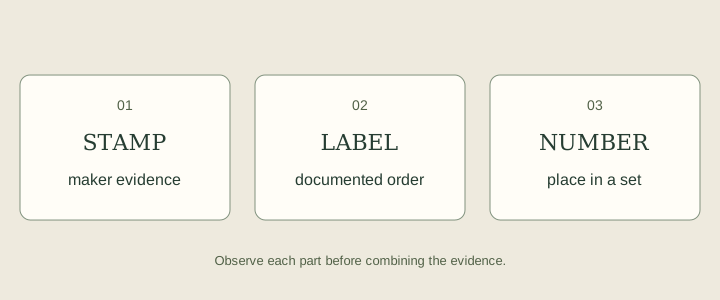
Three forms of evidence on a royal chair
The Met records a Georges Jacob armchair made in 1788 for Louis XVI’s gaming room at Saint Cloud. Its account describes a paper label identifying a February 1788 order and notches beside the maker’s stamp indicating the third chair in a supplementary group of four. The museum separately names Louis-François Chatard as the gilder and identifies the current gold brocaded silk as non-original. Maker, order, set position and upholstery history are distinct entries.
Map marks in their physical setting
Before transcribing an isolated stamp, record which rail carries it and its relationship to joints, labels and other marks. A general underside view followed by close details is more useful than a tightly cropped name alone. Use a mirror or an appropriate supported inspection arrangement where needed; do not tip a fragile chair onto vulnerable carving simply to get a photograph.
Leave unclear letters uncertain. A confident-looking expansion of a faint mark can turn a useful observation into an unsupported attribution.
Different marks support different claims
A paper label may describe an order or location. A set number may organise several pieces. A maker-related stamp addresses another part of the history. These clues gain meaning through comparison with records; they should not be treated as automatically interchangeable proof of authorship.
A famous name does not eliminate the need to examine construction and provenance. Record what the mark actually looks like, who interpreted it and which supporting source was used.
Keep upholstery and frame histories separate
The Met’s description explicitly distinguishes later fabric from the historic frame. This is a useful model for a collected chair: present upholstery should be recorded accurately without silently being assigned the frame’s date. A clear inventory can preserve a documented maker and acknowledge replacement coverings at the same time. When comparing a supposed set, record the marks and upholstery of every chair rather than extrapolating from one example.
| Part or term | What to record | Why it matters |
|---|---|---|
| Stamp | Letters and exact rail location | Maker-related evidence |
| Label | Text and attachment position | Order or ownership history |
| Number | Notches or other sequence | Relationship within a set |
Check your understanding
Do all underside marks have the same purpose?
Questions about antique french chairs
Is the Met chair’s gold silk original?
The catalogue explicitly states that it is not.
Should one chair stand for an entire set?
No. Record the evidence on each piece separately.
Related object guides
Sources and scope
Museum examples are comparisons, not authentication of objects offered elsewhere. The observation record and questions are editorial aids. Research checked 18 October 2026.