Vintage Linen Napkins · research note
Geometric linen: looking beyond floral patterns in damask napkins
Antique linen napkins do not all rely on floral decoration or plain white surfaces. Geometric design and added embroidery offer other ways to organise a table textile. Two museum records help distinguish the pattern of the woven cloth from decoration added with another material.
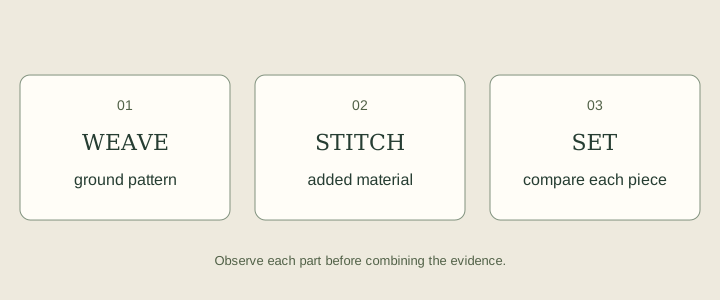
Two documented approaches
Cooper Hewitt records Mosaic, a linen damask napkin designed by Chris Lebeau and made by E.F.J. Van Dissel and Son in 1934. Its description identifies white warp and weft with yellow forming a fine grid. LACMA records Peter Behrens napkins made in Germany in 1904 as linen damask with wool embroidery. These examples show why linen should not automatically be treated as the only material in a decorated napkin.
Identify the layers of the design
Look first at the pattern visible across the woven cloth. Then note any stitching that sits above it or passes through it. Do not use embroidery as a catch-all word for every decorative effect. If the construction cannot be established from a photograph, describe the visible pattern and leave the technique uncertain.
A reverse view can help clarify the relationship, but it should be obtained without stretching a fragile textile. Record whether the reverse was actually inspected rather than assuming it matches the face.
Compare a group one piece at a time
For a set of napkins, compare dimensions, border placement, motif scale and any added stitching. Similar colour does not establish that every piece came from one original service. A later replacement may share the general design while differing in size or details.
Number the pieces in the record and photograph the same corner or border on each. This makes the comparison more reliable than a single folded stack, which hides much of the design.
Preserve the material distinction
A label saying linen damask with wool embroidery communicates more than linen napkin alone. It also tells the next owner that the textile combines materials. Keep that information with the object and consult appropriate textile-care advice before treatment. The design history and the present condition should remain separate: a well-documented designer does not establish that the fabric is strong enough for routine table use.
| Part or term | What to record | Why it matters |
|---|---|---|
| Ground | Woven pattern | Cloth construction |
| Addition | Embroidery or other work | Separate material layer |
| Group | Dimensions and repeated details | Tests set consistency |
Check your understanding
Does linen describe every material in a napkin?
Questions about antique linen napkins
Can damask carry geometric design?
Yes. The documented Mosaic napkin is one example.
What does LACMA list with linen damask?
Wool embroidery on the Behrens napkins.
Related object guides
Sources and scope
Museum examples are comparisons, not authentication of objects offered elsewhere. The observation record and questions are editorial aids. Research checked 18 October 2026.