Home Linens · identification & value
Antique Tablecloth
For a Sunday lunch in the French countryside, the best cloth came out of the armoire: heavy white damask woven with flowers or a monogram, or in the south a cheerful printed cotton of olives and lavender. Kitchen tables wore Basque linen with bands of colour, a style made for long tables at village feasts.
1850–1970
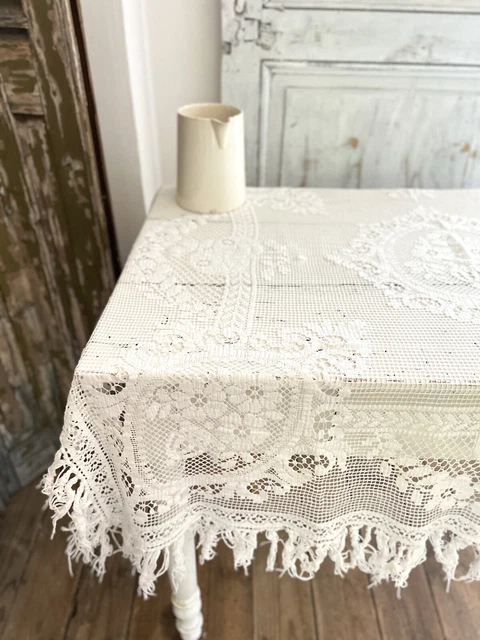
Typical asking price on live listings
about $110
Median of current eBay asking prices (via PicClick); listings run from $6 to $950. Asking prices are not sold prices.
Expert tip
Rub a corner between your fingers and look along a fold: pure linen feels cool, creases crisply and shows slightly uneven slub threads, while cotton feels soft and uniform and polyester blends spring back without creasing.
History
- Printed cottons copied from Indian calicoes spread in Provence from the 17th century; Souleiado took that name in the 1930s and revived old Provençal blocks.
- Linen damask and jacquard tablecloths were woven in quantity in the 19th and early 20th centuries for trousseaux.
Where it comes from
Provence for printed cottons (indiennes, Souleiado in Tarascon, Les Olivades); the Basque Country for striped linen; Northern France, the Vosges and Normandy for linen damask and woven jacquards.
Details to look at
- Fibre: linen, metis (linen-cotton) or cotton.
- Hems and monograms: hand-sewn or embroidered versus machine.
- Size and shape for the table it must cover.
The market: most wanted
- Large monogrammed linen damask cloths with matching napkins.
- Early Provençal block-printed cottons and vintage Souleiado.
- Old Basque striped linen in heavy weave.
Authenticity: period piece or reproduction?
- Hand-rolled hems show tiny irregular stitches; machine hems are perfectly even.
- Old damask has a dense, lustrous weave and softens with age.
- Faded fold lines and laundry marks are normal on period cloths.
- Warning signs: printed 'vintage' labels, bright polyester sheen, and printed patterns that do not continue across the hem.
Where to buy
- Linen dealers at L'Isle-sur-la-Sorgue, Saint-Ouen and Provençal markets; Leboncoin and Selency for lots; Souleiado and Basque weavers' shops for current production.
- In the US and UK, Etsy, eBay and French linen specialists; textile dealers at Round Top.
Buyer's checklist
- Measure against your table
- Fibre identified
- Stains and holes checked
- Monogram and hem hand-worked
Facts
- Typical size
- 150 × 150 cm to 180 × 350 cm
- Weight
- 0.5–2.5 kg
- Period
- 1850–1970
- Materials
- Linen, metis, cotton, damask and jacquard weaves
- US search interest
- 490 searches a month
Collector interest
Tablecloth draws 490 monthly US searches, split into 25 keyword variants.
By style, searches lean to french country (200), art deco (150).
Searches by country of origin: french (270).
Related in Home Linens
- Vintage Quilt
- Vintage Curtain
- Vintage Pillow
- Vintage Throw Pillow
- Vintage Throw Blanket
- Vintage Blanket
- Napkin Holder
- French Linen
Go deeper: research notes
The Vintage Linen Napkins: An Identification Guide gathers 11 sourced object studies, including: