Vintage Oyster Plates · research note
An oyster course across the Atlantic: Limoges and Brooklyn porcelain
Vintage oyster plates belong to a history of specialised dining as well as ceramic design. Comparing documented French-made and American-made examples shows why the food served cannot identify the factory. The same course could be expressed through different production networks and different designs.
A French factory and an American commission
The Met’s account of the Hayes state dinner service links American artist Theodore Russell Davis with Haviland’s porcelain production in Limoges. The oyster plate is dated about 1879–80. The museum describes the service as celebrating American wildlife, with decoration related to the different courses.
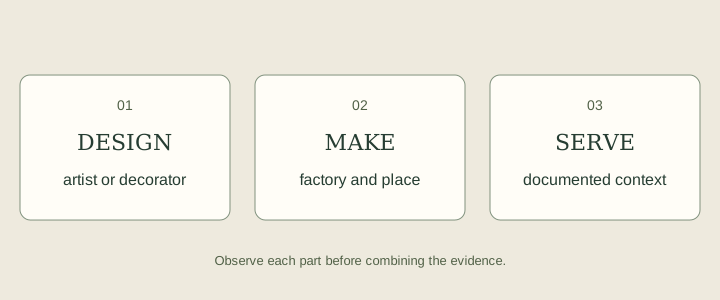
This separates three identities often compressed into one label: the designer, the place of manufacture and the intended setting. American imagery on French-made porcelain is not a contradiction; it is part of the object’s documented production history.
A Brooklyn comparison
The Met also holds a porcelain oyster plate by Union Porcelain Works, made in Brooklyn in 1881, accession 68.99.2. Its record gives dimensions of 21.7 by 16.5 cm. The two catalogue entries establish that the oyster course was served by production on both sides of the Atlantic.
They do not establish a relationship between every plate with shell decoration. A collector should compare a particular object with a particular record, retaining the maker and date attached to each example.
Build a production map
For each plate, make separate columns for designer or decorator, manufacturer, place and intended service. Leave a cell empty when the source supplies no answer. This avoids turning a prestigious commission into an assumption about all examples made by the same firm.
Add the exact source and object number. A named factory can have produced many designs, while an attractive plate found in France may have been made elsewhere. Purchase location belongs to the collecting history, not automatically to manufacture.
Read the dining context carefully
The museum connects the Hayes plate with the late nineteenth-century proliferation of specialised courses and serving pieces. That context helps explain why a distinct oyster plate existed. It does not show how an undocumented household used its own plate on a particular evening.
For a display, place the historical course description beside the individual object record. Readers can then understand both the broader dining practice and the limits of what is known about the piece in front of them.
| Part or term | What to record | Why it matters |
|---|---|---|
| Design | Artist or decorator when documented | Identifies the creative role |
| Manufacture | Factory and place | Separates production from imagery |
| Use context | Named service or documented course | Avoids transferring a famous commission |
Check your understanding
Can imagery alone establish where porcelain was made?
Questions about vintage oyster plates
Does American imagery prove American manufacture?
No. The Hayes example connects American designs with Limoges production.
Were oyster plates also made in Brooklyn?
Yes. The cited Union Porcelain Works plate is dated 1881.
Does buying a plate in France prove French origin?
No. Purchase location and production location are different.
Does a factory name prove White House use?
No. A specific service attribution needs evidence.
Related object guides
Sources and scope
Museum examples are comparisons, not authentication of objects offered elsewhere. The observation record and questions are editorial aids. Research checked 18 October 2026.