Vintage Majolica & Faience · research note
Majolica beyond the table: ceramic columns and a changing museum room
Majolica pottery is often encountered as a plate, jug or ornamental vessel. Architectural use offers another way to understand it: repeated ceramic units can become part of an entire room. The V&A provides a documented example in which original fabric, alteration and reconstruction need to be read together.
A gallery with ceramic columns
The V&A describes its original Ceramics Gallery as having ten columns covered in majolica, specified there as painted tin-glazed earthenware. The columns were stripped and boxed in by 1935. A 1995 restoration reconstructed two using both surviving tiles and newly made replacements. These are facts about a particular architectural installation, not a general chronology for domestic majolica.
Read the unit and the larger pattern
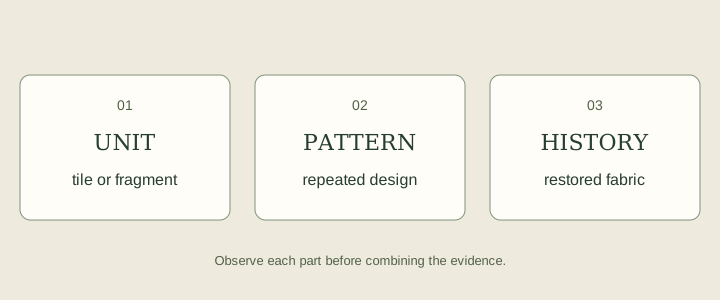
A loose architectural tile and a complete column offer different kinds of evidence. On an individual unit, record the decorated face, edge profile and any visible reverse. In an installation, note how repeated units meet, where borders begin and how a pattern turns around a curved surface.
A fragment may preserve only part of a larger motif. Resist assigning a complete original arrangement from one surviving piece unless a drawing, photograph or matching installation supports it.
Restoration is part of the visible result
A reconstructed room can contain old material and replacement material in one coherent design. The V&A history makes that distinction explicit. When using a restored interior as a comparison, note the restoration information beside its date rather than treating every visible surface as untouched original fabric.
The same approach helps with a repaired ceramic object. A complete silhouette and a uniform colour are observations; they do not settle which parts are original. Ask for documentation that distinguishes surviving fabric from restoration.
Use architectural context carefully
An architectural comparison can explain repetition, scale and the relationship between ceramics and surrounding decoration. It cannot identify the maker of an unrelated plate because the colours look similar. Keep the comparison focused on the question it can answer. For a room display of collected majolica, a sequence of repeating motifs can be described as a modern arrangement without claiming that the objects once formed an architectural suite.
| Part or term | What to record | Why it matters |
|---|---|---|
| Unit | Individual tile or fragment | Material evidence |
| Pattern | Relationship between units | Architectural composition |
| Restoration | Original and replacement fabric | Chronology of the display |
Check your understanding
Does a restored column contain only original tiles?
Questions about majolica pottery
What material does the V&A specify here?
Painted tin-glazed earthenware.
Can a column identify an unrelated plate?
Only with additional evidence; a shared colour scheme is insufficient.
Related object guides
Sources and scope
Museum examples are comparisons, not authentication of objects offered elsewhere. The observation record and questions are editorial aids. Research checked 18 October 2026.