Silver & Flatware · identification & value
Antique Spoon
In France the table was traditionally laid with spoons and forks face down, a custom that explains why French monograms and crests are engraved on the back of the handle. A family's silver spoons were often a wedding gift, engraved with the couple's initials, and passed down through generations of Sunday lunches.
1700–1950
Typical asking price on live listings
about $70
Median of current eBay asking prices (via PicClick); listings run from $7.99 to $5,500. Asking prices are not sold prices.
Expert tip
On a French silver spoon, look for the Minerva head hallmark (from 1838) with a number 1 for 950 silver or 2 for 800, next to a lozenge-shaped maker's mark; a mark in a square means silverplate.
History
- French silver standards and marks were regulated by law; the Minerva head has been the mark for French silver since 1838.
- 18th-century spoons often follow the 'uniplat' (plain) or 'filet' (threaded) patterns, still made today.
Where it comes from
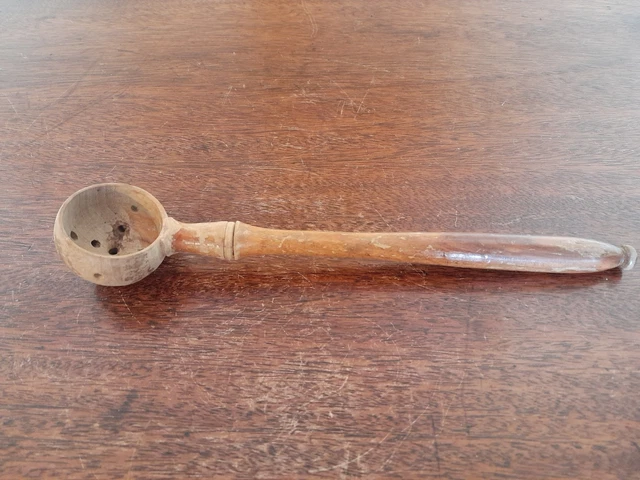
French silver spoons were made by Paris and provincial orfèvres and, from the 19th century, by large houses such as Christofle, Puiforcat and Odiot; carved wooden spoons come from country workshops, notably in the Alps, Brittany and the Basque country.
Details to look at
- Pattern of the handle: plain, threaded, shell or rococo.
- Marks on the back of the stem: hallmark, maker's lozenge, monogram.
- Bowl shape and wear: wear on the left side shows long use.
The market: most wanted
- 18th-century French provincial silver spoons with legible marks.
- Fine Paris makers such as Puiforcat and Odiot, especially in boxed sets.
- Christening, sugar-sifter and serving spoons in French silver.
Authenticity: period piece or reproduction?
- Period hallmarks are crisp but slightly worn with the spoon, never sharper than the surrounding surface.
- Hand-forged 18th-century spoons vary slightly in shape within a set.
- Wooden folk spoons show tool marks and uneven darkening with use.
- Warning signs: transposed marks cut from old spoons, fake 'Minerva' marks on plated metal, and wooden spoons with artificial black staining.
Where to buy
- In France, Saint-Ouen silver dealers, Drouot sales, Catawiki and regional brocantes for single spoons and sets.
- In the US and UK, eBay, Etsy, specialist silver dealers and Replacements for matching patterns.
Buyer's checklist
- Hallmarks legible
- Monogram on back
- Bowl wear
- Pattern matches set
Facts
- Typical size
- L 12–22 cm (table and dessert); serving spoons 25–35 cm
- Weight
- 20–100 g
- Period
- 1700–1950
- Materials
- Sterling (950 and 800) silver, silverplate, boxwood, fruitwood
- US search interest
- 1,830 searches a month
Collector interest
Spoon draws 1,830 monthly US searches, split into 49 keyword variants.
Style words in the queries: art deco (40), french country (10).
Material searches favour silver (310), wooden (260), copper (30), sterling (30).