Silver & Flatware · identification & value
Antique Fork
At Sauve, in the hills above Nîmes, growers pruned young micocoulier (nettle-tree) shoots so that each branch split into three, then left them on the tree for years before cutting, heating and shaping them into hay forks. On the table, meanwhile, the four-tined silver fork settled into French place settings in the 18th century and became standard in bourgeois homes through the 19th.
1800–1950
Typical asking price on live listings
about $120
Median of current eBay asking prices (via PicClick); listings run from $8.99 to $5,000. Asking prices are not sold prices.
Expert tip
On a wooden hay fork, look where the tines meet the shaft: a Sauve fork has no joint, nails or glue, because the tines grew from the same branch; pegged or nailed tines mean a later or assembled fork.
History
- The fourche de Sauve was made by a local cooperative tradition for centuries and is still produced in small numbers today, which keeps old and new examples side by side on the market.
- French silver table forks follow hallmark periods: the Minerva head mark for sterling-standard silver was used from 1838, and silver-plated forks by Christofle and Ercuis multiplied after the 1840s electroplating patents.
Where it comes from
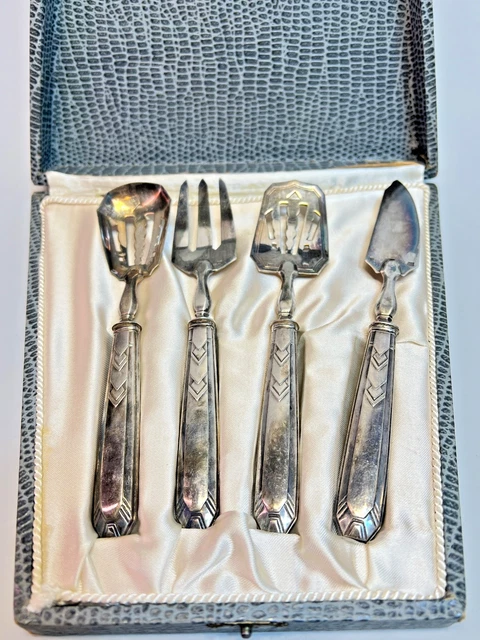
Two traditions share the name: table forks from Paris silversmiths and provincial hallmark offices, and wooden hay forks from the Cévennes village of Sauve (Gard), famous for its three-tined forks grown from the micocoulier tree.
Details to look at
- On hay forks: the shaft's natural taper, worn polish where the hands held it, and tines with dark patina at the tips.
- On silver forks: the hallmark (Minerva head plus a maker's lozenge) on the back of the stem.
- The pattern: plain uniplat versus filet, Louis XV rocaille or Art Nouveau patterns.
The market: most wanted
- Old three-tined Sauve hay forks with deep patina and long shafts.
- Solid silver forks by Puiforcat, Odiot or Christofle in sets of twelve with original box.
- Engraved monogram sets from the Louis-Philippe and Napoleon III periods in heavy gauge.
Authenticity: period piece or reproduction?
- A genuine Minerva mark is a small helmeted profile; the 950 or 800 standard is indicated by the number beside the head (1 or 2).
- Silver plate is marked with a square maker's punch and often a weight figure (e.g. 84 or 90 grams of silver per dozen).
- An old hay fork is light for its length and dry to the touch; new forks are pale and smell of fresh wood.
- Warning signs: brass forks sold as 'antique gold', stained new Sauve forks, and plate marks passed off as solid silver.
Where to buy
- Hay forks turn up at Provence and Cévennes brocantes, L'Isle-sur-la-Sorgue and on Leboncoin; silver forks at Drouot sales, Catawiki and Proantic.
- In the US and UK, eBay and Etsy are the main sources for single forks and sets; 1stDibs and Chairish carry hay forks as decor and fine French silver sets.
Buyer's checklist
- Hallmark or plate mark
- Tine wear and alignment
- Monogram erased?
- For hay forks: one-piece tines
Facts
- Typical size
- Table fork L 18–22 cm · hay fork L 150–200 cm
- Weight
- Silver fork 50–90 g · hay fork 0.8–1.5 kg
- Period
- 1800–1950
- Materials
- Sterling silver, silver plate (métal argenté), brass, micocoulier wood
- US search interest
- 700 searches a month
Collector interest
Search demand for fork reaches 700 US searches a month across 25 distinct queries.
The styles people attach to it most are art deco (10).
Most-searched materials: brass (80).