Serving Pieces · identification & value
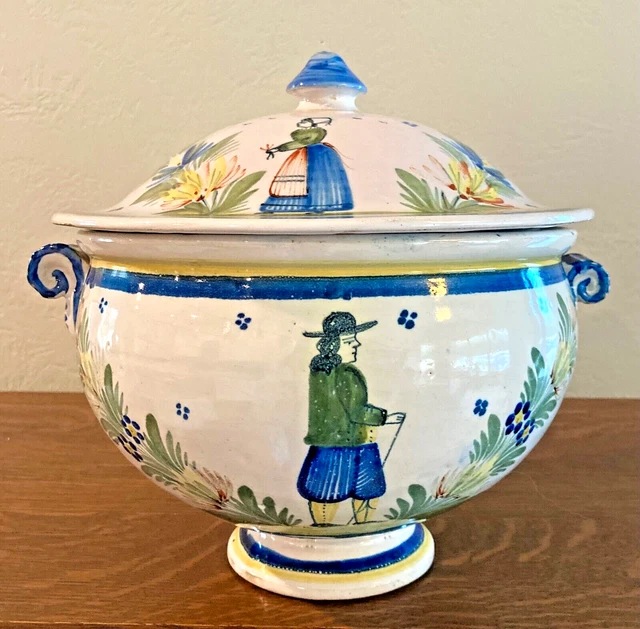
Antique Tureen
In the 18th century, soup opened the French dinner and came to the table in a tureen (soupière) placed at the centre of the service. Strasbourg potters turned these into sculpture, making tureens shaped as cabbages, boars' heads and birds that are now among the most prized pieces of French faience.
1740–1930
Verified market data (US$)
$77 – $605 – $20,350
lowest · median · highest observed
French dealers asking on Proantic: €70–18 500 (median €550, 60 listings). (Proantic prices converted to USD at 1 EUR = $1.10.)
Expert tip
Lift the lid and compare its body, glaze colour and mark with the base: a 'married' lid from another tureen is common and halves the value, and the clue is often a slightly different white or a lid that rocks on the rim.
History
- Strasbourg faience under the Hannong family (mid-18th century) produced celebrated trompe-l'oeil tureens; Marseille's Veuve Perrin workshop marked pieces 'VP'.
- From the 19th century, Creil-Montereau, Gien and Sarreguemines made sturdy earthenware tureens for every household; English ironstone followed Mason's patent of 1813, and the crowned 'N' of Capodimonte was widely reused long after the Naples factory of 1743–1759.
Where it comes from
French faience from Strasbourg, Marseille (Veuve Perrin) and Niderviller; fine earthenware from Creil-Montereau, Gien and Sarreguemines; porcelain from Limoges; ironstone is English, Capodimonte Italian.
Details to look at
- The lid finial (artichoke, fruit, animal) and whether it is chipped or reglued.
- The ladle notch in the lid and whether a matching ladle survives.
- Handles and feet, the most often restored parts.
The market: most wanted
- 18th-century Strasbourg and Marseille faience tureens, especially figural ones.
- Complete tureens with stand (présentoir) and ladle from Gien or Creil-Montereau.
- Early English Mason's ironstone with the impressed patent mark.
Authenticity: period piece or reproduction?
- Tin-glazed faience chips to a soft buff or reddish body; porcelain chips to glassy white.
- Period marks are painted or impressed under the glaze, not printed on top.
- Wear rings on the base foot and fine scratches inside from ladles.
- Warning signs: Capodimonte 'crowned N' on brightly coloured, heavily moulded modern pieces, glossy overpainting hiding repairs, and lids that don't fit.
Where to buy
- Puces de Saint-Ouen and Proantic for faience; regional brocantes and Leboncoin for Gien, Sarreguemines and Limoges services; Drouot for 18th-century pieces.
- In the US and UK, Etsy, eBay and Replacements-type china dealers for ironstone and Limoges; 1stDibs for important faience.
Buyer's checklist
- Lid matches base
- Finial and handles intact
- Hairlines under raking light
- Ladle and stand present
Facts
- Typical size
- H 20–35 cm · W 25–45 cm
- Weight
- 2–6 kg
- Period
- 1740–1930
- Materials
- Faience (tin-glazed earthenware), fine earthenware, ironstone, porcelain
- US search interest
- 180 searches a month
Collector interest
Search demand for tureen reaches 180 US searches a month across 5 distinct queries.
Origins in the queries: french (10).
Related in Serving Pieces
- Antique Salt Cellar
- Vintage Gravy Boat
- Covered Dishes: Butter & Casserole
- Vintage Butter Dish
- Serving Pieces with Lids
- Vintage Platter
- Vintage Soup Tureen
- Vintage Serving Tray
Go deeper: research notes
The Vintage Soup Tureens: An Identification Guide gathers 11 sourced object studies, including:
- Turtle-shaped tureens and turtle soup: form is not a menu
- Silver tureens assembled from cast parts and removable liners
- An electrotype tureen cover and the two dates in its history
See also: Vintage Trays.