Serving Pieces · identification & value
Antique Compote
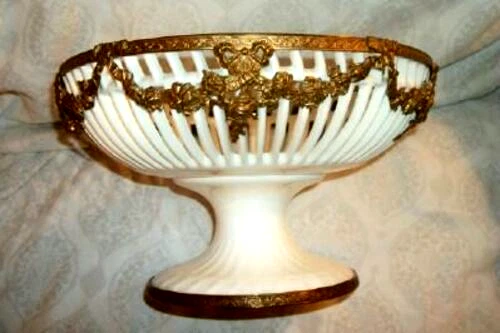
On a 19th-century French table the compotier stood at the centre of dessert: a raised bowl on a foot, piled with stewed fruit or pears in syrup, set between the cheese and the coffee. Whole dessert services included two or four of them at different heights.
1830–1970
Typical asking price on live listings
about $129
Median of current eBay asking prices (via PicClick); listings run from $10 to $7,500. Asking prices are not sold prices.
Expert tip
Turn it over and read the underside of the foot: French earthenware compotiers are usually stamped with the factory mark (Creil et Montereau, Gien, Sarreguemines) in black or blue, and English ironstone carries an impressed or printed Staffordshire maker.
History
- Fine earthenware dessert services with footed compotiers were produced in quantity at Creil, Montereau, Gien and Sarreguemines through the 19th century.
- Pressed opaline and milk glass compotes spread in the late 19th century from Lorraine in France and from American glasshouses; Fenton Art Glass, founded in Ohio in 1905, made its milk glass compotes in huge numbers from the mid-20th century.
Where it comes from
French compotiers came from Creil-Montereau, Gien and Sarreguemines (fine earthenware), Limoges (porcelain) and the Lorraine glassworks of Portieux and Vallérysthal (opaline); the milk glass and ironstone compotes sought in the US are mostly American (Fenton) and English (Staffordshire).
Details to look at
- The foot: one piece with the bowl or a separate stem.
- Rim shape: plain, scalloped, lattice or beaded.
- Surface: glaze crazing on earthenware, mould seams on pressed glass.
The market: most wanted
- Complete French faience dessert services with matching compotiers at several heights.
- White ironstone compotes in named 19th-century patterns.
- Early opaline and fine hobnail milk glass with crisp moulding.
Authenticity: period piece or reproduction?
- French fine earthenware is light for its size, with a clear glaze and printed mark.
- Older milk glass often shows an opalescent halo when held up to a light; flat chalk-white glass is usually later.
- Fenton marked its pieces with an embossed logo only from 1970, so an unmarked Fenton shape is usually earlier.
- Warning signs: brand-new stilt marks, transfer decals that sit on top of the glaze, and pressed glass with soft, worn-looking detail straight from the mould.
Where to buy
- Regional brocantes and vide-greniers in France for faience compotiers; Leboncoin and Selency for sets.
- Etsy, eBay and US antique malls for Fenton milk glass and ironstone; Round Top for white ironstone groupings.
Buyer's checklist
- Mark under foot
- Chips on rim
- Crazing or stains
- Foot joint solid
Facts
- Typical size
- H 10–25 cm · Ø 18–28 cm
- Weight
- 0.4–1.5 kg
- Period
- 1830–1970
- Materials
- Fine earthenware (faïence fine), ironstone, porcelain, opaline, milk glass, pressed glass
- US search interest
- 850 searches a month
Collector interest
US shoppers type 850 searches a month about compote, spread over 4 keyword variants.
Most-searched materials: glass (640).
Related in Serving Pieces
- Antique Salt Cellar
- Vintage Gravy Boat
- Covered Dishes: Butter & Casserole
- Vintage Butter Dish
- Serving Pieces with Lids
- Vintage Platter
- Vintage Soup Tureen
- Vintage Serving Tray
Go deeper: research notes
The Vintage Soup Tureens: An Identification Guide gathers 11 sourced object studies, including:
- Turtle-shaped tureens and turtle soup: form is not a menu
- Silver tureens assembled from cast parts and removable liners
- An electrotype tureen cover and the two dates in its history
See also: Vintage Trays.