French Confit Pots · research note
Old repairs on a confit pot: seams, staples and the handling decision
A confit pot can preserve several histories at once: manufacture, use, damage and repair. A repaired handle or body seam deserves its own record. The aim of an initial inspection is to identify visible evidence and decide what needs specialist assessment, without disturbing the repair to find out more.
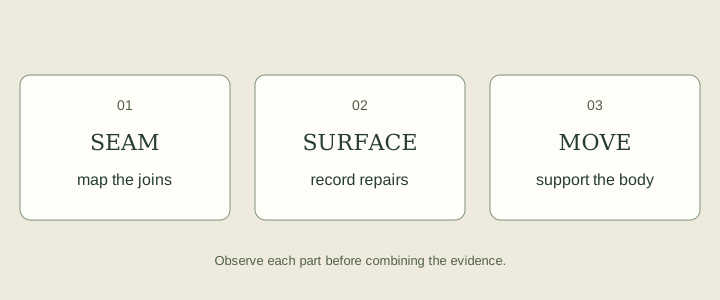
Recognise the signs without diagnosing the adhesive
The Canadian Conservation Institute lists glue lines, adhesive residue, metal staples or rivets, fills and overpainting as signs of ceramic repair. It notes that repaired areas can be weaker and that repairs are part of an object’s history. These general ceramic principles apply to the inspection of a confit pot, but they do not identify the age or composition of any particular repair.
Build a seam map
Use an overall photograph to mark the position of each visible join, then take a detail showing its relation to the rim, handle or foot. Number the photographs so a short note such as seam 2 below left handle has an unambiguous reference.
Distinguish a visible line from a confirmed join. If a surface is covered by paint or a fill, record that the underlying area is not visible. A smooth outer surface is not evidence that the body has never been broken.
Let condition change the handling plan
CCI advises supporting ceramic objects beneath their centre of gravity and warns against picking them up by handles or spouts. This is particularly relevant when a confit pot’s projecting handles look convenient but have uncertain joins. The pot should not be lifted by a handle simply to test whether a repair holds.
Before moving a large example, decide where it can be supported and where it will be placed. If instability, loose fragments or an inaccessible heavy body makes that uncertain, obtain professional handling advice rather than improvising a strength test.
Document before considering treatment
An old repair may be visually distracting, historically informative, structurally weak, or several of these at once. Those are separate assessments. Do not scrape a seam to identify glue or remove staples for a cleaner photograph. Record the evidence and ask a ceramic conservator about treatment options when needed.
For a purchase record, ask what has been repaired, who carried out the work if known, and whether supporting documentation exists. Unknown is a useful answer; invisible repair is not a complete condition report.
| Part or term | What to record | Why it matters |
|---|---|---|
| Seam | Position and photographs | Locates the repair |
| Surface | Residue, fill or overpaint | Records visible evidence |
| Handling | Supported body and clear route | Avoids testing handles |
Check your understanding
Should a repaired handle be tested by lifting?
Questions about confit pot
Does glue colour identify a repair date?
Not reliably from appearance alone.
Should old staples be removed for inspection?
No. Record them and seek conservation advice if treatment is needed.
Related object guides
Sources and scope
Museum examples are comparisons, not authentication of objects offered elsewhere. The observation record and questions are editorial aids. Research checked 18 October 2026.