French Confit Pots · research note
French confit pots: vessel names, glaze and evidence
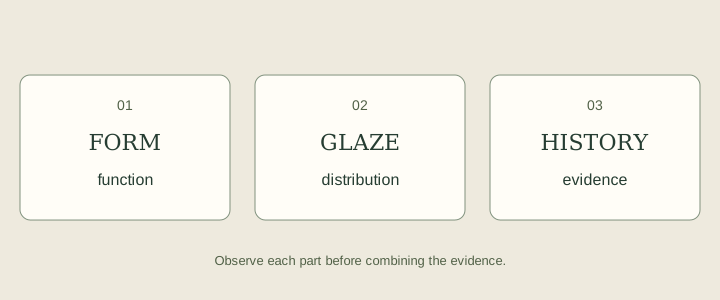
A confit pot belongs to the vocabulary of food storage, but the name should not be attached to every rustic glazed jar without examination. Form, opening, handles, body and surface treatment all need recording. This guide explains how to describe a French-market confit pot while keeping its proposed use, geographical origin and date separate. An attractive yellow or green glaze is a feature, not a complete provenance.
A specific name within a wider storage vocabulary
French museum terminology distinguishes many domestic vessel names. The Ministry of Culture's descriptive system lists pot à confit alongside names such as pot à confitures and pot à graisse. That vocabulary is useful because it preserves differences in proposed function instead of reducing every storage pot to one fashionable collecting label.
When a vessel is offered as a confit pot, ask what supports that identification. The answer may involve a documented regional form, collection history or a catalogue comparison. Record the source. A seller's location in France does not establish the place of manufacture, and a container's suitability for a modern decorative arrangement does not prove its historical contents.
Observe the glaze boundary and the exposed body
Describe which parts of the vessel are glazed: interior, rim, shoulder, handles and lower body. Photograph the boundary between coated and exposed areas where present. A partly glazed surface is an observation to compare, not a universal dating test. Do not assume that every colour variation comes from age or that every unglazed area indicates the same manufacturing practice.
Record chips already present at the rim or base without enlarging them to inspect the fabric. Note the body colour visible in those areas and keep material identification appropriately qualified. A rustic appearance can arise through several production and use histories. Clear photographs of the complete profile are more useful than a close-up of glaze alone.
Handles, repairs and present-day display
Examine handle attachments, the rim and the foot separately. A crack or old repair may be concealed by the angle of a styled photograph. Request an interior view and ask whether the vessel has been drilled or adapted, for example as a lamp. An adaptation is part of the object's later history and should be documented explicitly.
For display, measure the opening as well as the overall height and widest diameter. If flowers are planned, an independent inner container avoids asking an untested old pot to retain water. Do not infer present suitability for food storage from the historical name. Preserve the written description, images and any credible origin information together; those records are more durable than a general impression of country-house character.
| Part or term | What to record | Why it matters |
|---|---|---|
| Name | Source of the proposed function | Confit is not a universal jar label |
| Surface | Glazed and exposed areas | Describe boundaries without dating from colour |
| Structure | Rim, handles, foot and repairs | Condition and later adaptations |
Check your understanding
What does a yellow glaze establish by itself?
Questions about confit pot
Is every half-glazed pot a confit pot?
No. Record the glaze distribution and complete form, then compare reliable descriptions of the proposed vessel type. A surface feature alone cannot establish former contents, country or date. Keep the name qualified when its use is based only on a seller’s impression.
Does yellow glaze prove a French origin?
Colour is a visible feature rather than a geographical certificate. Investigate the body, form, manufacturing evidence and documented history together. A purchase made in France can establish where an object was acquired, but it does not by itself establish where it was produced.
Can an old confit pot be used as a vase?
Assess its condition and support before deciding on display. An independent waterproof inner vessel can separate flowers and water from the historic container. Do not assume an old glazed surface remains watertight, particularly where cracks, restoration or an unknown adaptation history are involved.
What should be recorded about a converted lamp?
Record holes, fittings and any changes to the rim or base, with photographs showing their location. The adaptation belongs to the object’s later history and should not be concealed. It may affect handling and display as well as the interpretation of the original vessel.
Related object guides
Sources and scope
Museum examples are comparisons, not authentication of objects offered elsewhere. The observation record and questions are editorial aids. Research checked 16 October 2026.