Antique Olive Jars · research note
Antique olive jars: storage forms and Mediterranean labels
Antique olive jars are discussed in both archaeology and interior decoration, but the same name can cover different vessel traditions. A large terracotta jar is not automatically a French olive-storage vessel. The mouth, shoulder, body, base and documented context provide the useful evidence. This guide explains why a precise description begins with form and provenance rather than a broad Mediterranean appearance.
One name can conceal different contexts
The National Museum of Bermuda describes olive jars recovered in the context of the Spanish ship San Antonio, wrecked in 1621. Its account explains that such containers carried liquids and small provisions, including wine, grapes and olives. The name therefore should not be taken as proof that every vessel bearing it held only olives.
Those archaeological shipping containers should not be casually equated with every large garden jar offered under a French or Mediterranean label. A comparison needs the actual form and context. Record the source of a claimed origin, whether it is excavation, a collection history, a maker or a seller's attribution. Where the evidence is absent, keep the geographical description qualified.
Describe the profile in a consistent order
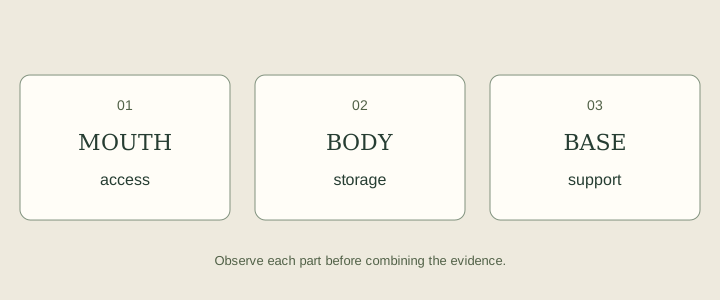
Begin at the mouth and move down to the neck, shoulder, body and base. Record whether handles are present and where they join. Measure overall height, maximum diameter and opening size separately. A silhouette photographed without scale can make a modest storage vessel look monumental, while a narrow mouth may be hidden by a floral arrangement.
Photograph the base and accessible interior as well as the front. Note visible glaze, unglazed areas, surface deposits and existing chips. Do not remove deposits or scrape the body to improve identification photographs. A shaped vessel and its surface treatment may carry evidence that an intervention would make harder to interpret.
Repairs and adaptations affect display decisions
Ask whether the jar has been reconstructed, filled, drilled or converted for another purpose. Map visible cracks and restoration by location. A sound-looking rim does not explain the condition of the lower body or base. For a heavy vessel, obtain weight and handling information before planning transport or an elevated display.
Outdoor placement introduces a different set of questions from indoor display. Do not assume that an object sold as rustic pottery is suitable for permanent exposure. Its body, glaze, repairs and drainage arrangements all matter. Keep the decorative ambition separate from the evidence about present condition; an unsupported claim of weather resistance should not follow from a historic-looking surface.
| Part or term | What to record | Why it matters |
|---|---|---|
| Mouth and neck | Opening and profile | Access and comparison of vessel forms |
| Body and base | Dimensions, support and repairs | Condition and handling |
| Provenance | Place, context and source of attribution | Distinguishing traditions with similar names |
Check your understanding
What does the name olive jar establish about its exact former contents?
Questions about antique olive jars
Did every olive jar contain olives?
No universal content can be inferred from the name. The Bermuda museum describes shipping jars used for several provisions and liquids. Investigate the particular vessel tradition and any reliable history rather than converting a conventional label into a claim about actual former contents.
Is a Mediterranean shape proof of French manufacture?
A broad visual association is not a precise origin. Compare the profile, material and documented examples, and ask what evidence supports the country claim. A jar bought in France may have a different manufacturing history from the place where it was acquired.
Can a large old jar stay outdoors all year?
That requires an assessment of the actual body, glaze, repairs and exposure conditions. Decorative appearance is not a durability specification. Ask about previous use and restoration, and avoid treating the word terracotta or a rustic finish as a guarantee of outdoor suitability.
Which measurements matter for positioning?
Record height, widest diameter, opening and base footprint, together with weight when available. Handles and an uneven profile may affect access and support. A photograph beside furniture is helpful context, but it should not replace measured information for transport or display.
Related object guides
Sources and scope
Museum examples are comparisons, not authentication of objects offered elsewhere. The observation record and questions are editorial aids. Research checked 16 October 2026.