Mirrors & Trumeaux · identification & value
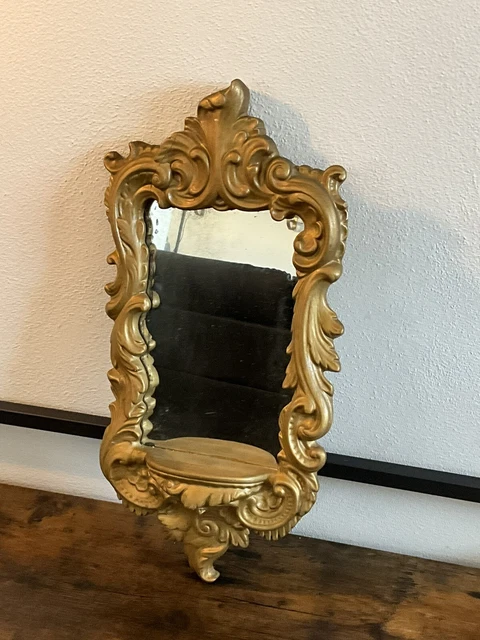
Mirror with Shelf
In the Victorian parlour, the space above the fireplace was a display case: a tall overmantel mirror framed by little shelves for vases, fans and photographs. Across the Channel, the French village barber and the farmhouse hallway used something simpler, a mirror with a narrow ledge for a comb, a brush or the house keys.
1870–1950
Typical asking price on live listings
about $659
Median of current eBay asking prices (via PicClick); listings run from $19 to $46,000. Asking prices are not sold prices.
Expert tip
Look behind the shelf: an original shelf is fixed through the frame from the back with old slotted screws or tenoned into the uprights, and the finish matches; a shelf added later is screwed through the face of the frame, often with new screws and a slightly different stain.
History
- Overmantel mirrors with shelves and spindled galleries were fashionable in England from the 1870s to about 1900, often in ebonised or walnut wood under the Aesthetic movement.
- Art Deco bathroom mirrors with bevelled edges and glass or chromed shelves were made in France and Belgium in the 1920s and 30s.
Where it comes from
England for Victorian and Aesthetic-movement overmantel mirrors with tiers of shelves; French provincial workshops for oak and pine barber's and hall mirrors with a small console shelf; Paris and Brussels for Art Deco bathroom mirrors with glass or chrome shelves.
Details to look at
- Shelf construction: solid wood with a moulded edge, turned spindle galleries, or a thick glass shelf on chrome or brass brackets.
- Mirror plate: bevelled or flat, with old silvering and the frame rebate it sits in.
- Frame wood and finish: ebonised with incised gilt lines (Aesthetic), pitch pine or oak (country), chrome or painted (Deco).
The market: most wanted
- English Aesthetic-movement overmantels in ebonised wood with bevelled mirror panels and turned galleries.
- French oak barber's or hall mirrors with carved crests and a small console shelf.
- Art Deco bathroom mirrors with bevelled glass, chrome brackets and thick glass shelves.
Authenticity: period piece or reproduction?
- The shelf and frame should show the same patina, dust lines and old fixings; differences in colour mean later additions.
- Bevelled edges on old mirrors are wide and soft, ground by hand, with slight unevenness; modern machine bevels are narrow and sharp.
- Chrome on Deco brackets wears through to yellow brass at edges; modern brackets are stainless steel or new plate.
- Warning signs: a shelf cut from new wood, shelves glued on, and 'vintage' bathroom mirrors with modern silvering and plastic clips.
Where to buy
- Saint-Ouen, brocantes, Leboncoin and Selency for French mirrors with shelves; salvage yards for Art Deco bathroom mirrors.
- In the US and UK, eBay, Etsy, Chairish and English antiques centres for overmantel mirrors.
Buyer's checklist
- Shelf fixing
- Bevel quality
- Matching finish
- Bracket material
Facts
- Typical size
- H 50–150 cm · W 40–120 cm · shelf D 8–15 cm
- Weight
- 3–25 kg
- Period
- 1870–1950
- Materials
- Ebonised wood, walnut, oak, pine, chrome, brass, bevelled glass, mirror plate
- US search interest
- 220 searches a month
Collector interest
US shoppers type 220 searches a month about mirror shelf, spread over 14 keyword variants.
By style, searches lean to farmhouse (20).
The materials buyers name are brass (30), wooden (10).
Related in Mirrors & Trumeaux
- Antique Mirror
- Antique Vanity Mirror
- Antique Dresser Mirror
- Vintage Wall Mirror
- Antique Venetian Mirror
- Vintage Bathroom Mirror
- Full-Length Mirror
- Vintage Floor Mirror
Go deeper: research notes
The Antique Mirrors: An Identification Guide gathers 12 sourced object studies, including:
- The psyché mirror in Morisot’s painting: a tilting dressing mirror in context
- Venetian mirrors with engraved panels: reading a composite surface
- A pocket-sized mirror in tortoiseshell and silver
See also: Antique French Trumeau Mirrors.