Mirrors & Trumeaux · identification & value
Louis-Philippe Mirror
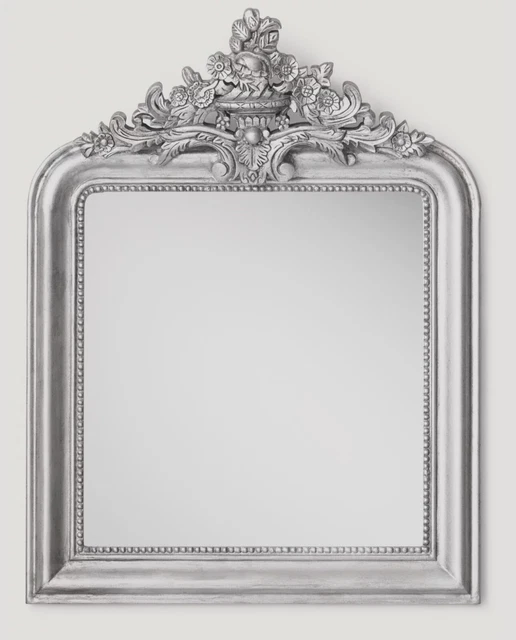
Under King Louis-Philippe (1830–1848), the French middle class furnished its new apartments with sober, practical luxury. Above every mantelpiece went a tall gilt mirror with a rounded or straight top and simple moulded frame, often with a palmette or shell at the corners. Thousands were made, and they still turn up in French homes and markets today.
1830–1890
Typical asking price on live listings
about $250
Median of current eBay asking prices (via PicClick); listings run from $2.5 to $7,500. Asking prices are not sold prices.
Expert tip
Turn it over: an original Louis-Philippe mirror has a softwood frame with the gilt profile applied as moulded gesso, and a wooden backboard; a cast-resin frame or a hardboard back means a modern copy.
History
- The style is named after Louis-Philippe I, King of the French from 1830 to 1848, and was made well into the second half of the 19th century.
- Frames were usually gilt gesso on pine, produced in quantity by Paris and provincial workshops.
Where it comes from
Paris and provincial gilders across France, especially the north and the Lyon area, during the July Monarchy and later.
Details to look at
- Arched, rounded or straight top with corner ornaments.
- Water gilding or oil gilding over red or ochre bole.
- Original mercury or early silvered plate.
The market: most wanted
- Large overmantel examples over 150 cm with fine corner palmettes.
- Mirrors with original mercury glass and untouched gilding.
- Rare painted or black-and-gold versions.
Authenticity: period piece or reproduction?
- Real gold leaf wears to show red or yellow bole and white gesso, not bare plastic.
- Old glass has grey foxing and a softer reflection.
- Frames are built in mitred pine with hand-cut nails or wooden wedges at the back.
- Warning signs: identical 'Louis Philippe' mirrors from home-decor chains, bright gold paint, plastic ornaments and screwed-on D-ring hangers on fresh wood.
Where to buy
- Saint-Ouen, L'Isle-sur-la-Sorgue, Leboncoin and regional brocantes, where they are one of the commonest antique mirrors; Proantic for large gilded examples.
- In the US and UK, 1stDibs, Chairish, Etsy and eBay, plus French antiques importers.
Buyer's checklist
- Gilding wear pattern
- Glass condition
- Back construction
- Corner ornaments intact
Facts
- Typical size
- H 70–180 cm · W 50–110 cm
- Weight
- 8–30 kg
- Period
- 1830–1890
- Materials
- Pine, gesso, gold leaf or gilt paint, silvered glass
- US search interest
- 610 searches a month
Collector interest
Philippe mirror draws 610 monthly US searches, split into 10 keyword variants.
The materials buyers name are gold (110).
Searcher intent: 2% want background or definitions.
Related in Mirrors & Trumeaux
- Antique Mirror
- Antique Vanity Mirror
- Antique Dresser Mirror
- Vintage Wall Mirror
- Antique Venetian Mirror
- Vintage Bathroom Mirror
- Full-Length Mirror
- Vintage Floor Mirror
Go deeper: research notes
The Antique Mirrors: An Identification Guide gathers 12 sourced object studies, including:
- The psyché mirror in Morisot’s painting: a tilting dressing mirror in context
- Venetian mirrors with engraved panels: reading a composite surface
- A pocket-sized mirror in tortoiseshell and silver
See also: Antique French Trumeau Mirrors.