Jewelry · identification & value
Vintage Diamond Ring
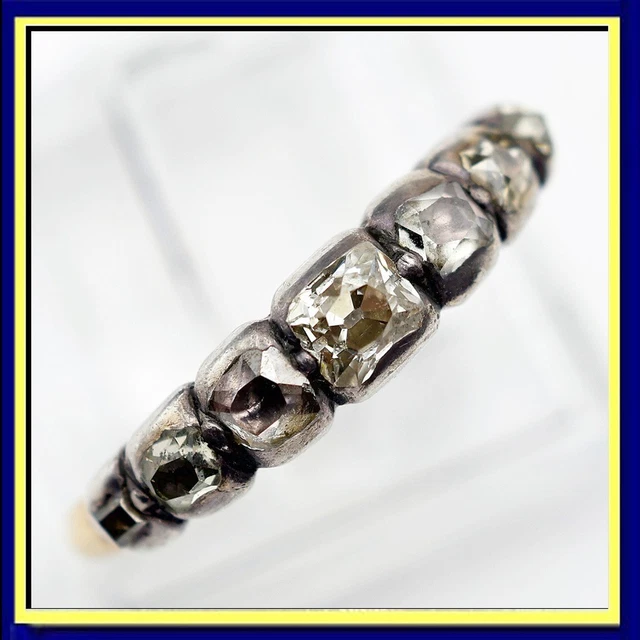
Before electricity, diamonds were cut to sparkle by candlelight: old mine cuts with high crowns and big, broad flashes of colour. A legend says the long, pointed marquise shape was cut to match the smile of the Marquise de Pompadour, though no document proves it. By the 1920s, Paris jewellers were mounting diamonds in platinum with geometric settings that defined the Art Deco ring.
1780–1940
Typical asking price on live listings
about $2,496
Median of current eBay asking prices (via PicClick); listings run from $369 to $78,000. Asking prices are not sold prices.
On eBay (via PicClick), 23 listings for “antique french diamond ring” median asking price $1,850; median 14 watchers per listing.
Expert tip
Look straight down through the top of the diamond with a loupe: a small circle in the centre is an open culet, the mark of an old mine or old European cut; modern brilliants come to a point.
History
- Old mine cuts were standard in the 18th and 19th centuries; the old European cut became common in the late 19th century.
- Rose-cut diamonds were used in Georgian and Victorian rings, often in clusters.
- Art Deco rings (1920–1935) combined diamonds with sapphires, emeralds and calibré stones in platinum.
Where it comes from
Paris for French antique diamond rings (the Place Vendôme houses and many smaller ateliers); much of the old mine cut supply is English, Dutch (Amsterdam cutting) and American.
Details to look at
- The cut: cushion-shaped old mine, round old European, flat-backed rose cut, or step cuts such as Asscher and emerald.
- The setting: Georgian closed backs (sometimes foiled), Victorian claws, or Edwardian and Deco millegrain edges.
- The metal: silver-topped gold before about 1900, then platinum or white gold for the white look of the 1910s–30s.
The market: most wanted
- Old mine and old European diamonds over one carat with good colour, which are no longer cut today.
- Art Deco platinum rings combining diamonds with calibré sapphires, and period Asscher cuts.
- Georgian rose-cut clusters and long navette (marquise-shaped) rings.
Authenticity: period piece or reproduction?
- Old cuts have a high crown, small table, open culet and slightly asymmetric facets cut by eye.
- A closed-back Georgian setting can hide foil or glass: ask whether the stone has been tested.
- Hand-fabricated settings show solder joints and slight irregularities; cast copies show porosity under a loupe.
- Warning signs: modern brilliants in old mounts, laser inscriptions on the girdle of an 'antique' stone, synthetic moissanite, and no written grading.
Where to buy
- In France, Drouot sales with expert reports, Paris antique jewellers around the Opéra and Place Vendôme, and Catawiki for tested and hallmarked rings.
- In the US and UK, 1stDibs and specialist antique jewellers who give stone weights and grading; eBay only with lab reports and return rights.
Buyer's checklist
- Cut
- Lab report
- Setting secure
- Hallmark
Facts
- Typical size
- Head 5–20 mm · band 2–3 mm
- Weight
- 2–8 g
- Period
- 1780–1940
- Materials
- Diamond, platinum, gold, silver, sapphire, emerald
- US search interest
- 7,850 searches a month
Collector interest
Search demand for diamond ring reaches 7,850 US searches a month across 234 distinct queries.
By style, searches lean to art deco (3,570), victorian (40).
Material searches favour diamond (7,850), stone (90), gold (80).