Planters, Pots & Urns · identification & value
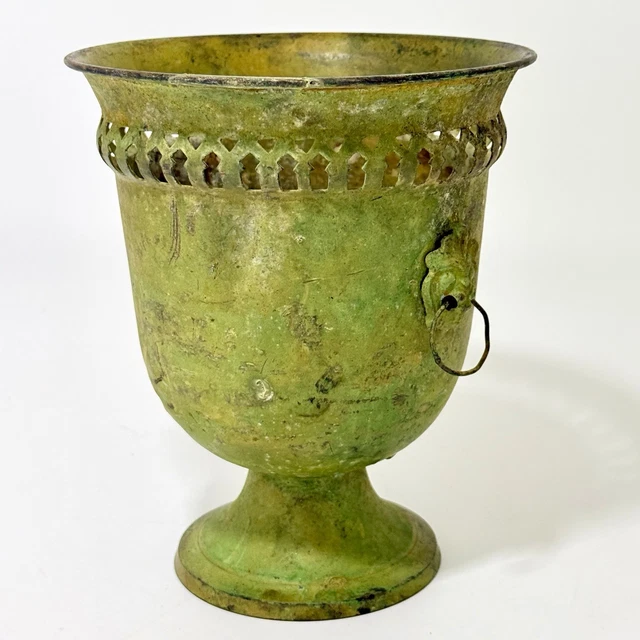
Antique Urn Planter
In the mid-19th century the foundries of the Haute-Marne sent cast-iron vases along the new railways to parks, cemeteries and château gardens all over France. Shaped after antique models like the Medici and Borghese vases, they were painted to imitate bronze or stone and filled with geraniums each summer.
1840–1930
Typical asking price on live listings
about $159
Median of current eBay asking prices (via PicClick); listings run from $14 to $12,000. Asking prices are not sold prices.
Expert tip
Search the plinth, socle and underside for a cast foundry mark (for example 'Val d'Osne' or 'A. Durenne Sommevoire'); also check how the sections join, because originals are bolted with square-headed bolts through cast lugs, not welded.
History
- French art foundries in the Haute-Marne, including Val d'Osne (from 1836) and Durenne, produced cast-iron garden urns and statues in quantity from the 1840s.
- Classical shapes copied the Medici and Borghese vases; catalogues offered sizes and ornaments to order.
- Victorian Britain and the US produced their own cast-iron urns; J.W. Fiske of New York was a major American maker.
Where it comes from
Haute-Marne foundries above all: Val d'Osne and Durenne (Sommevoire), plus Ducel and other French art foundries; in Britain Coalbrookdale and Handyside, and in the US J.W. Fiske of New York.
Details to look at
- The shape: campana (Medici) bowls with egg-and-dart rims, gadrooned lower bodies and sometimes mask or scroll handles.
- The surface: several layers of old paint (often black, green or bronze-imitation) over rust, with lichen in the recesses.
- The base: a separate socle and square plinth bolted through, with a cast drainage hole in the bowl.
The market: most wanted
- Signed Val d'Osne and Durenne urns, especially matched pairs with original plinths.
- Large Medici and Borghese urns over 80 cm with handles and ornamented socles.
- Marked J.W. Fiske, Coalbrookdale or Handyside urns in Britain and the US.
Authenticity: period piece or reproduction?
- Old cast iron has a fine granular sand-cast surface and seams filed smooth; ornament is crisp under the paint.
- Lift a corner: the walls of a period urn are 6–10 mm thick, and a 60 cm urn should take two people to move.
- Rust that has flaked, been painted over and rusted again leaves a layered, pitted surface that is hard to fake.
- Warning signs: thin modern castings with blurred ornament, unfiled seams, cast aluminium (light and non-magnetic), and foundry names cast into new pieces.
Where to buy
- In France: L'Isle-sur-la-Sorgue, architectural salvage yards (dépôts de matériaux anciens) and Leboncoin for single urns and pairs; Drouot and regional auctions for signed foundry pieces.
- In the US and UK: 1stDibs, Chairish, garden antiques dealers, salvage yards and country-house sales.
Buyer's checklist
- Foundry mark
- Cracks and repairs
- Bolts
- Pair matching
Facts
- Typical size
- H 40–120 cm · Ø 35–90 cm
- Weight
- 30–150 kg
- Period
- 1840–1930
- Materials
- Cast iron, paint, lead (bowls), zinc
- US search interest
- 350 searches a month
Collector interest
US shoppers type 350 searches a month about urn planter, spread over 13 keyword variants.
Style words in the queries: rustic (10), french country (10).
Most-searched materials: cast iron (210), brass (20), copper (20).