Garden Iron & Metal · identification & value
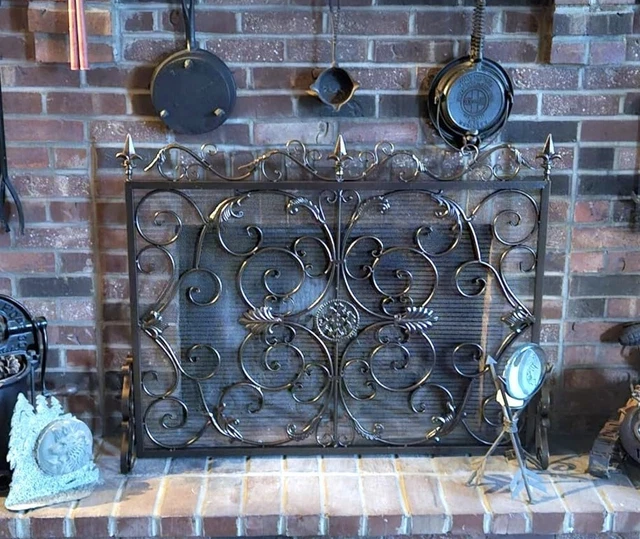
Wrought Iron Fireplace Screen
Once coal replaced wood in French town houses, the open hearth spat sparks onto parquet and rugs, and a pare-étincelles became as necessary as the fire irons. In the 1920s Paris ironworkers turned that humble guard into a showpiece, hammering scrolls, fountains and stylised flowers into screens that sat in front of the fire all summer long.
1850–1950
Verified market data (US$)
$165 – $858 – $4,950
lowest · median · highest observed
French dealers asking on Proantic: €150–4 500 (median €780, 60 listings). (Proantic prices converted to USD at 1 EUR = $1.10.)
Expert tip
Look closely at the mesh: old spark guards use fine woven iron or brass wire set into a channel in the frame, while modern copies use coarse expanded or welded mesh tacked on with spot welds.
History
- Upholstered or painted fire screens (écrans de cheminée) stood before hearths from the 18th century; metal-mesh spark guards became common in the 19th century with coal grates.
- In the Art Deco years Edgar Brandt and other Paris ferronniers made fire screens a vehicle for their best hand-forged work.
Where it comes from
Hand-forged screens from French ferronniers everywhere; cast-iron screens from the Haute-Marne foundries (Val d'Osne, Durenne); Art Deco wrought iron from Paris workshops such as Edgar Brandt's.
Details to look at
- Hand-hammered texture and forge marks on scrolls, collars and finials.
- Mesh fitted in a groove or riveted, with an even, aged patina.
- Folding three-panel versus single-panel design, and whether the feet stand flat.
The market: most wanted
- Signed Art Deco wrought-iron screens by Edgar Brandt and his Paris contemporaries.
- Napoleon III gilt-bronze and brass screens with fine woven mesh.
- Large Haute-Marne cast-iron screens with crisp foundry detail.
Authenticity: period piece or reproduction?
- Hand-forged iron shows slight irregularities, tapered ends and collars wrapped hot around joints.
- Old cast iron has a sandy, slightly pitted surface and crisp edges where the mould was good.
- Forged scrolls are joined by rivets or collars, not by modern weld beads.
- Warning signs: bright weld beads, Phillips screws, uniform machine-bent scrolls and fresh black paint hiding everything.
Where to buy
- Brocantes in Burgundy and Champagne, L'Isle-sur-la-Sorgue and Saint-Ouen for wrought-iron and brass screens; Proantic and Drouot sales for signed Art Deco ironwork.
- In the US and UK, 1stDibs, Chairish, eBay and architectural salvage dealers carry period screens alongside many reproductions.
Buyer's checklist
- Mesh intact and original
- Joints riveted, not welded
- Stands level and stable
- Signature or stamp if claimed
Facts
- Typical size
- H 60–90 cm · W 60–120 cm (open)
- Weight
- 5–25 kg
- Period
- 1850–1950
- Materials
- Wrought iron, cast iron, brass, gilt bronze, iron or brass wire mesh
- US search interest
- 500 searches a month
Collector interest
Fireplace screen draws 500 monthly US searches, split into 6 keyword variants.
Most-searched materials: wrought iron (380), cast iron (120).