Vintage Brass Candlesticks · research note
Brass chambersticks: the saucer, handle and movable socket
Among antique brass candlesticks, the chamberstick deserves its own description. Its low arrangement, collecting tray and handle relate to portable lighting rather than simply to a tall tabletop display. Some examples also include a mechanism beneath the candle. Understanding that combination helps distinguish a complete object from a group of attractive but unrelated fittings.
A lighting form organised around carrying
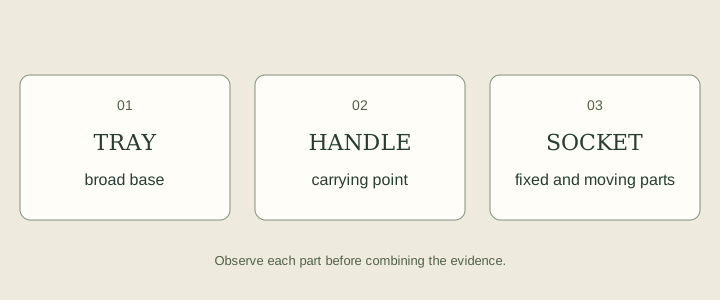
A chamberstick brings the candle socket close to a tray-like base and provides a handle or finger loop. The broad base and the handle should be studied together, since the complete assembly explains how the object was held and supported. Not every shallow metal dish with a central socket has the same construction. Record the handle attachment, the socket and any additional fittings before choosing a more specific name.
A documented brass example
The New York Historical collection records chamberstick 1933.83 as American, dated 1780–1830, in brass and iron. Its description identifies a cylindrical socket, a saucer base, a finger loop and a movable socket bottom operated by a side lever. This record provides a precise vocabulary for a mechanism that might otherwise be mistaken for damage or an unexplained projecting piece. It does not establish that another similar chamberstick shares the same date or origin.
Separate the movable part from the fixed socket
Look for a slot or lever and record where it meets the socket. A surviving mechanism can be documented without forcing it to move. Deposits, distortion or an incomplete component may prevent operation, and a photograph cannot establish what happens inside. Ask for condition information specific to the mechanism rather than accepting a general description such as good antique condition.
If a piece is missing, describe its location and the surviving connection. Do not substitute a guessed replacement simply because it fits the opening. The relationship between the original construction and any later alteration is part of the object’s history.
Understand associated tools as separate objects
The Met’s London chamberstick of 1792 by John Scofield retains snuffers by Wilkes Booth and is catalogued in gilded silver. The museum notes that such portable lights were used to move around a home and that accompanying components often went missing. This is a comparison of function and completeness, not a brass identification reference.
A tool offered beside a brass chamberstick should therefore receive its own description. Record whether it has a dedicated resting place and what evidence connects it to the holder. Similar colour alone does not demonstrate an original association.
Record function without requiring renewed candle use
A chamberstick can explain domestic lighting while being displayed empty. The presence of a handle does not guarantee that an old soldered or riveted joint is safe to carry, and an old socket need not be tested with a burning candle. Keep the historical explanation separate from the present condition assessment. A useful record describes the base, handle, socket, movable parts and associated tools individually, then explains how they form the whole.
| Part or term | What to record | Why it matters |
|---|---|---|
| Tray and handle | Carrying arrangement | Check their connection |
| Socket and lever | Fixed and movable components | Do not force operation |
| Associated tool | Separate identity and fit | Association needs evidence |
Check your understanding
What does the Met’s silver example help compare?
Questions about antique brass candlesticks
Is a chamberstick always brass?
No. The form exists in other materials; the Met example discussed here is gilded silver.
Does a side lever mean the object is broken?
Not necessarily. It may operate a movable part of the socket, as in the New York Historical example.
Are matching snuffers automatically original?
No. Their association should be investigated separately.
Can the handle be used as a lifting point?
Do not assume an old attachment is sound. Obtain handling advice appropriate to the actual condition.
Related object guides
Sources and scope
- New York Historical: Chamberstick, 1780–1830, 1933.83
- The Metropolitan Museum of Art: John Scofield, Chamberstick with snuffers, 1792
Museum examples are comparisons, not authentication of objects offered elsewhere. The observation record and questions are editorial aids. Research checked 16 October 2026.