Statues & Curiosities · identification & value
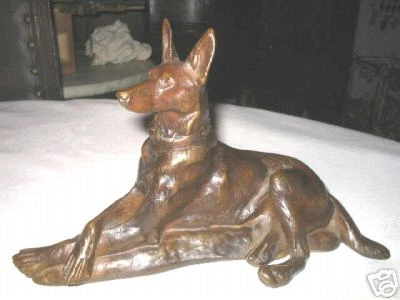
Antique Dog Statue
In the Paris Salons of the 1830s and 40s, sculptors such as Barye and Mêne made animals a subject in their own right. Hunting hounds, pointers and greyhounds cast in bronze sold to a new middle class who wanted their dogs and hunting days on the mantelpiece.
1830–1940
Typical asking price on live listings
about $295
Median of current eBay asking prices (via PicClick); listings run from $5 to $2,300. Asking prices are not sold prices.
Expert tip
Look on the bronze terrace (the base it stands on) for a signature cast into the metal, such as 'P.J. MENE' or 'BARYE', and a foundry mark; then lightly scratch an inconspicuous spot under the base: bronze shows golden, spelter shows silver-grey.
History
- Antoine-Louis Barye (1795–1875) and Pierre-Jules Mêne (1810–1879) led the animalier school; Mêne specialised in dogs, horses and hunting groups.
- Art Deco greyhounds and borzois in spelter or bronze on marble bases were popular in the 1920s–30s.
Where it comes from
Paris for the 19th-century animalier bronzes cast by founders such as Barbedienne and Susse Frères; Paris and the provinces for Art Deco spelter dogs; Staffordshire in England for pottery dogs.
Details to look at
- Signature cast into the terrace (not scratched afterwards) and a foundry stamp such as 'F. Barbedienne Fondeur' or 'Susse Frères Éditeurs'.
- Chasing: individually tooled fur, collar buckles, claws and the texture of the naturalistic ground on the terrace.
- Patina: rich brown or green-brown on 19th-century bronze; spelter was painted or chemically 'bronzed', and wears to silver-grey on high points.
The market: most wanted
- Pierre-Jules Mêne pointers, setters, greyhounds and hound-pack groups, especially lifetime casts.
- Antoine-Louis Barye dogs and hunting groups cast by Barbedienne or in Barye's own foundry.
- Art Deco greyhounds and borzois in bronze or spelter on marble or onyx bases, and English Staffordshire pottery spaniels for the country look.
Authenticity: period piece or reproduction?
- Bronze is heavy and rings when tapped with a fingernail; spelter is lighter, dull-sounding, and can bend at thin points like ears and legs.
- Period casts show crisp detail and chasing; later surmoulages (casts taken from a finished bronze) are softer and roughly 1–2 per cent smaller, since metal shrinks as it cools.
- Underneath, old casts show hand-finished seams, an open or plugged base and threaded fixing rods with old square or hex nuts.
- Warning signs: identical 'Mêne' dogs offered by the dozen online, a uniform shiny brown patina, signatures engraved after casting, and Asian bronzes with rough grey interiors and sand still inside.
Where to buy
- Drouot and regional hôtels des ventes, Proantic and Saint-Ouen for signed bronzes; brocantes and Leboncoin for spelter and Art Deco dogs.
- In the US and UK, 1stDibs, specialist animalier dealers, Christie's and Bonhams sales, and eBay for spelter and Staffordshire pottery dogs.
Buyer's checklist
- Signature
- Scratch test
- Detail sharpness
- Foundry mark
Facts
- Typical size
- H 10–45 cm · L 15–60 cm
- Weight
- 1–15 kg
- Period
- 1830–1940
- Materials
- Bronze, spelter, marble, terracotta, cast iron, pottery
- US search interest
- 230 searches a month
Collector interest
Search demand for dog statue reaches 230 US searches a month across 8 distinct queries.
The styles people attach to it most are art deco (10).
The materials buyers name are bronze (60).