Statues & Curiosities · identification & value
Art Deco Knobs
Open the door of a 1930s Paris apartment and your hand meets a cool chromed knob, or a glass one cut like a diamond; in a farmhouse, a white porcelain knob or a brass olive (bouton olive). These small pieces, unscrewed when houses were modernised, now fill boxes at every brocante.
1850–1960
Typical asking price on live listings
about $55
Median of current eBay asking prices (via PicClick); listings run from $4.72 to $275. Asking prices are not sold prices.
Expert tip
Measure the square hole for the spindle: French knobs are metric, commonly 6 or 7 mm, while American knobs take a 5/16-inch (about 8 mm) spindle; a beautiful French knob may not fit an American lock without an adapter.
History
- Brass and porcelain door knobs were standard in French houses through the 19th century; the Vimeu district of Picardy was the centre of French lock and hardware making.
- Art Deco knobs in chrome, Bakelite and pressed glass belong to the 1925–1945 period.
Where it comes from
French locksmith-hardware makers in Paris and the Picardy Vimeu (the traditional French lock and hardware district) for brass and porcelain door knobs; Art Deco knobs in Bakelite, chrome and glass from French and American makers.
Details to look at
- The fixing: screw thread, square spindle or wood screw.
- The material: solid brass, porcelain, glass, Bakelite, chrome over brass.
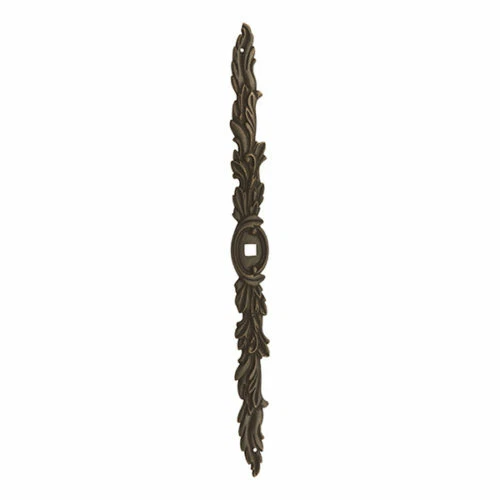
- The rose (backplate): matching or replacement.
The market: most wanted
- Pairs and full house sets of Art Deco knobs with roses.
- Cut crystal and coloured glass knobs from the 1920s–30s.
- Bronze knobs by known Paris hardware makers.
Authenticity: period piece or reproduction?
- Old brass has a warm, uneven patina and is heavy; plated zinc alloy is light and shows grey under the plating.
- Bakelite smells of formaldehyde when rubbed hard or run under hot water.
- Old glass knobs have slight bubbles and a ground base.
- Warning signs: identical 'antique' knobs in large quantities, modern Phillips screws and plated finishes wearing to grey metal.
Where to buy
- Regional brocantes and L'Isle-sur-la-Sorgue for boxes of knobs; architectural salvage yards and Leboncoin for complete house sets.
- In the US and UK, Etsy, eBay and architectural salvage shops; buy pairs and check the spindle size first.
Buyer's checklist
- Spindle size
- Matching pairs
- Material test
- Roses included
Facts
- Typical size
- Knob Ø 3–7 cm · rose Ø 5–8 cm
- Weight
- 50–300 g per knob
- Period
- 1850–1960
- Materials
- Brass, bronze, porcelain, glass, Bakelite, chromed metal
- US search interest
- 150 searches a month
Collector interest
US shoppers type 150 searches a month about knob, spread over 12 keyword variants.
Style words in the queries: art deco (120), french country (20).
Most-searched materials: glass (10).