Boxes & Smoking Accessories · identification & value
Vintage Humidor
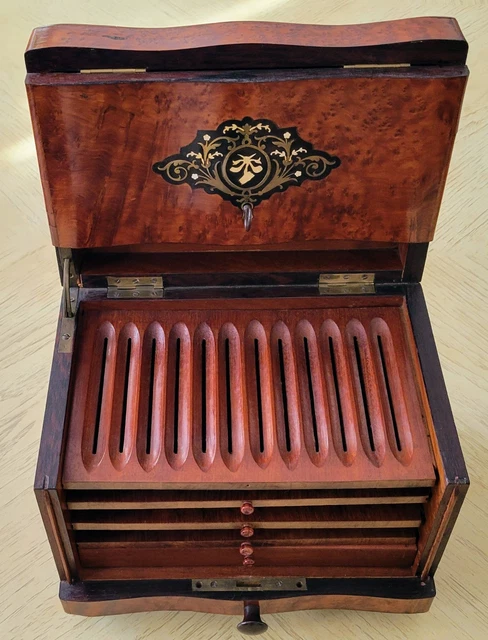
Under the Second Empire, Havana cigars became the mark of a Paris gentleman, and cabinetmakers built humidors in rosewood or lacquer with brass hinges and secret compartments. The Art Deco era refined them into geometric boxes with macassar ebony veneers and chrome fittings.
1850–1960
Verified market data (US$)
$220 – $1,045 – $5,472
lowest · median · highest observed
French dealers asking on Proantic: €200–4 975 (median €950, 29 listings). (Proantic prices converted to USD at 1 EUR = $1.10.)
Expert tip
Close the lid slowly: a good humidor lid should sink on a cushion of air and close with a soft seal, and the interior should be lined in Spanish cedar, recognizable by its scent.
History
- Cigar smoking spread in France in the 19th century, with the state tobacco monopoly established in 1810.
- Saint-Claude in the Jura became the centre of French briar pipe making in the second half of the 19th century.
- Alfred Dunhill opened his London tobacco shop in 1907 and produced humidors and smoking accessories.
Where it comes from
Paris tabletiers and Art Deco ébénistes for cigar boxes and humidors; Saint-Claude (Jura), the French pipe capital, for smoking accessories; London (Alfred Dunhill) for many collected humidors; faience tobacco jars from Nevers and Rouen.
Details to look at
- Spanish cedar lining and hygrometer.
- Seal and fit of the lid.
- Veneers, inlay and metal fittings.
The market: most wanted
- Art Deco humidors in macassar ebony, shagreen or lacquer.
- Dunhill humidors with original fittings.
- Second Empire rosewood or lacquer cigar cabinets.
Authenticity: period piece or reproduction?
- Old Spanish cedar linings are solid boards, mitred or dovetailed in the corners, with a faded surface that releases scent when lightly scratched; veneered cedar on plywood is modern.
- A Dunhill humidor usually carries the Dunhill name on a plaque, inside the lid or on the lock; a copper or zinc-lined smoking cabinet keeps its tray and humidifier.
- Art Deco boxes in macassar ebony or shagreen have fine veneers that may show small shrinkage cracks, and chromed or silvered fittings fixed with slotted screws.
- Warning signs: modern brand-name humidors sold as vintage, cedar-effect paper liners, Phillips screws and new digital hygrometers in an 'antique' box.
Where to buy
- Saint-Ouen and Catawiki for Art Deco humidors and cigar boxes; Drouot for signed pieces; brocantes in the Jura for Saint-Claude smoking accessories.
- 1stDibs, eBay and specialist tobacco-antique dealers in London and the US for Dunhill pieces.
Buyer's checklist
- Cedar lining
- Lid seal
- Hygrometer
- Veneer condition
Facts
- Typical size
- L 25–50 cm · W 20–35 cm · H 10–25 cm; cabinets H 60–100 cm
- Weight
- 2–8 kg; cabinets 15–30 kg
- Period
- 1850–1960
- Materials
- Rosewood, mahogany, macassar ebony, Spanish cedar, brass, chrome
- US search interest
- 100 searches a month
Collector interest
US shoppers type 100 searches a month about humidor, spread over 6 keyword variants.
Style words in the queries: art deco (90).
Most-searched materials: copper (10).