Boxes & Smoking Accessories · identification & value
Vintage Jewelry Box
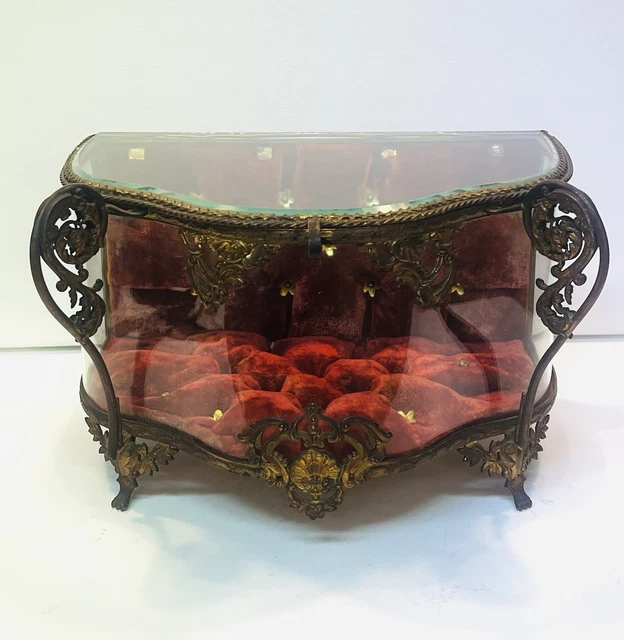
In the 1850s and 60s, the Paris luxury trade made small, precious boxes for the jewellery, gloves and letters of the bourgeoisie: ebonised wood inlaid with brass and tortoiseshell, palissandre with mother-of-pearl, or bronze with porcelain plaques. Makers such as Tahan supplied the court of Napoleon III. Later, in the 20th century, musical jewellery boxes with a spinning ballerina became childhood keepsakes.
1840–1960
Guide price (US$)
$30 – $120 – $1,000
low · typical · high, dealer level
Price tip: under $30 is a bargain worth checking twice; above $1,000, ask for provenance or a maker's mark.
Verified market data (US$)
$88 – $660 – $27,500
lowest · median · highest observed
French dealers asking on Proantic: €80–25 000 (median €600, 60 listings). (Proantic prices converted to USD at 1 EUR = $1.10.)
Expert tip
Open the lid and look for a maker's mark: Napoleon III boxes often carry the name of the Paris retailer or maker (such as Tahan) on the lock plate or inside the lid, and a working lock with its original key adds value.
History
- The Paris tabletterie trade flourished under the Second Empire (1852–1870).
- Boulle-style inlay of brass and tortoiseshell was revived in the 19th century for boxes and small furniture.
- Ballerina music boxes were made in quantity from the mid-20th century.
Where it comes from
Paris for Napoleon III luxury boxes (Tahan and other tabletiers of the Palais-Royal and Rue de la Paix); Méru in the Oise for mother-of-pearl, bone and fan work; the Black Forest and Switzerland for carved and musical boxes; Japan for 20th-century ballerina music boxes.
What sets the price
Material, maker.
Details to look at
- The decoration: brass and tortoiseshell inlay, mother-of-pearl, bone, applied bronze or porcelain plaques.
- The lock, key and any maker's or retailer's mark on the lock plate or inside the lid.
- The interior: quilted silk or velvet lining, lift-out trays, ring rolls and mirror.
The market: most wanted
- Signed Napoleon III boxes by Paris makers such as Tahan.
- Boulle-inlaid jewellery caskets in brass and red or brown tortoiseshell.
- Bronze-mounted and porcelain-plaque caskets, and signed Art Deco boxes in lacquer or shagreen.
Authenticity: period piece or reproduction?
- Old inlay is cut by hand, with small irregularities and slight lifting where the wood has moved.
- Original silk linings are faded and worn at the edges; bright new velvet suggests a re-lined box.
- Real tortoiseshell shows a natural mottled pattern under a lens; plastic imitations are uniform.
- Warning signs: printed veneers, resin 'bronze', modern locks with no key, and new tortoiseshell-style plastic.
Where to buy
- In France, Saint-Ouen and Drouot for signed Napoleon III boxes, regional brocantes and Leboncoin for simpler wooden and mother-of-pearl boxes.
- In the US and UK, eBay and Etsy for vintage and ballerina boxes, 1stDibs for fine Napoleon III caskets. The guide range is $30–1,000.
Buyer's checklist
- Lock and key
- Inlay complete
- Lining
- Hinges
Facts
- Typical size
- L 15–40 cm · H 8–20 cm
- Weight
- 0.5–4 kg
- Period
- 1840–1960
- Materials
- Ebonised wood, rosewood, brass, tortoiseshell, mother-of-pearl, bronze, silk
- US search interest
- 5,840 searches a month
Collector interest
Search demand for jewelry box reaches 5,840 US searches a month across 86 distinct queries.
Style words in the queries: art deco (120), victorian (80), art nouveau (10), retro (10).
The materials buyers name are silver (60), wood (60), brass (30), pewter (20).