Antique Baskets · research note
Antique egg baskets: weave, handles and working form
An antique egg basket should be understood through its shape, construction and documented use. A handle and an open weave do not prove that a basket carried eggs, nor do they establish a date. Begin with the base, walls, rim and handle attachments. This guide explains how to record those parts and distinguish a useful functional description from an appealing but unsupported rural history.
Use the name with appropriate precision
A basket offered as an egg basket may have a form suited to gathering or carrying, but the label still needs support. Record whether the attribution comes from a maker's description, a collection history, a catalogue comparison or a seller's impression. “Basket described as an egg basket” is more accurate than presenting an uncertain former use as established fact.
Describe the actual outline: round, oval, shallow, deep or divided. Record the opening dimensions and overall height including the handle. A narrow opening, projecting handle or uneven base affects display and storage even when it contributes to the character of the object. Do not use the number of eggs in a staged photograph as a capacity measurement.
Follow the construction from base to rim
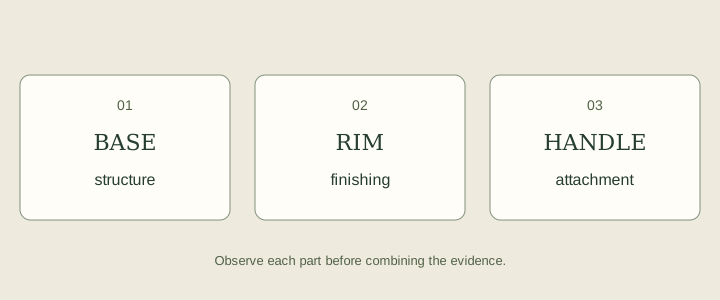
Examine the base first, then the transition into the walls and the finishing at the rim. Note broken elements, loose ends and repairs. Photograph the handle where it joins or passes through the body rather than recording only its arch. An attractive upper section can conceal a weakened load path at the attachment.
Material should be described carefully. Wicker describes woven work in common collecting language; it should not be treated as a precise botanical identification. Different plant materials and treatments can produce similar visual effects. Record visible structure and any reliable maker information before assigning a species or regional technique.
A collecting object needs support as well as description
The Canadian Conservation Institute advises careful handling of basketry and attention to its environment. Its guidance explains that light damage is cumulative and that changing humidity can affect plant materials and constrained components. Those principles favour a stable display and thoughtful support over routinely using a fragile historical basket for carrying.
Assess the base, rim and handle independently. Do not pull loose strands tight, bend brittle material back into shape or add moisture to test flexibility. Record dust, staining and damage without assuming that every dark area has the same cause. If a repair is needed, retain photographs of the original structure and consult someone familiar with basketry rather than disguising a broken element with an improvised binding.
| Part or term | What to record | Why it matters |
|---|---|---|
| Base | Weave, breaks and distortion | How the body is supported |
| Rim | Finishing and loose ends | Integrity of the opening |
| Handle | Attachment and repairs | Condition before any carrying use |
Check your understanding
What is the safest first assessment of an old handle?
Questions about antique egg basket
Does wicker identify a plant species?
Not precisely. It is commonly used for woven objects and does not alone tell you which plant material was used. Record the visible construction and any reliable documentation, then keep a more specific material identification qualified until it has been established.
Can a handle be used as a strength test?
Pulling or loading a handle can damage a weak attachment. Examine its junctions and support the basket appropriately instead. A historical carrying function does not establish present strength, particularly where strands are broken, brittle or concealed by later repairs.
Do uneven shapes prove hand manufacture or age?
Irregularity is an observation with several possible causes, including original construction and later distortion. It does not supply a date on its own. Compare the structure and documented examples, and describe the particular variation rather than using a general claim of rustic authenticity.
What should accompany a regional attribution?
Ask for a catalogue comparison, maker information or a documented collection history. Record which features support the claim and where uncertainty remains. A market location or a familiar basket shape is not enough to establish that the object was made in a particular French region.
Related object guides
Sources and scope
Museum examples are comparisons, not authentication of objects offered elsewhere. The observation record and questions are editorial aids. Research checked 16 October 2026.