Tables & Consoles · identification & value
Antique Tea Table
Tea arrived in English society in the second half of the 17th century and quickly became a social ritual hosted by the lady of the house. By the 1750s, cabinetmakers made small tripod tables with tilting tops so that the table could be set aside against a wall, and the most fashionable had carved piecrust edges to keep the porcelain safe.
1740–1900
Verified market data (US$)
$132 – $946 – $17,875
lowest · median · highest observed
French dealers asking on Proantic: €120–16 250 (median €860, 59 listings). (Proantic prices converted to USD at 1 EUR = $1.10.)
Expert tip
On a tilt-top table, look across the grain: a solid top from a single board shrinks over two centuries and is slightly oval (narrower across the grain than along it); a perfectly round top with fresh screw holes in the 'birdcage' or block beneath suggests a replaced or married top.
History
- Tea drinking spread in England after the Restoration (1660); tea tables became a distinct form in the early 18th century.
- Tilt-top tripod tables with birdcage mechanisms and piecrust edges were made in mahogany in the mid-18th century, the Chippendale period.
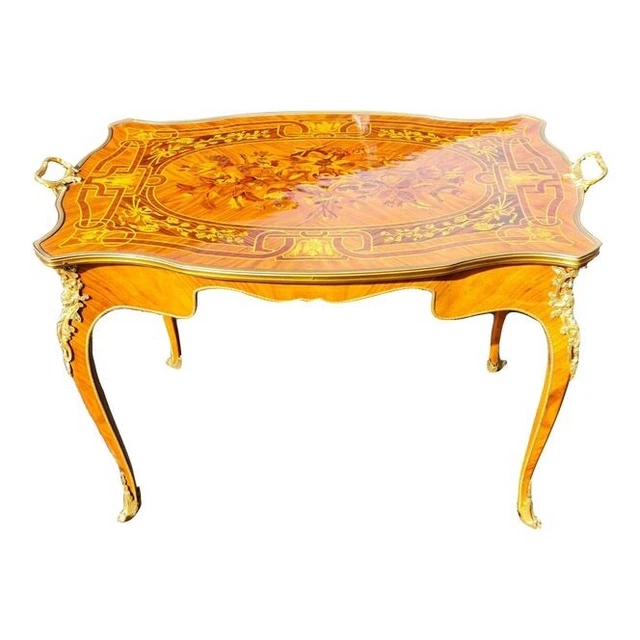
- French Napoleon III tea tables (tables à thé) with two tiers, marquetry and brass galleries were made in Paris in the second half of the 19th century.
Where it comes from
England for the classic Georgian tea table, from tilt-top tripod tables with piecrust edges to fold-over card-and-tea tables; Paris for the Napoleon III table à thé with tiers and brass galleries; China for the low lacquered and hardwood tea tables also sought by buyers.
Details to look at
- The top: a single board of dense mahogany, either plain, dished (turned with a raised rim) or carved with a scalloped piecrust edge.
- The base: a turned column on a tripod with carved knees and pad, snake or claw-and-ball feet; the 'birdcage', two small platforms joined by columns, lets the top both tilt and turn.
- On French tables: two tiers, removable tray tops, pierced brass galleries, marquetry or ebonised finishes with gilt-bronze mounts.
The market: most wanted
- Georgian mahogany piecrust tilt-top tables with birdcage and claw-and-ball feet, the more carving the higher the value.
- Colonial American tilt-top tea tables, especially from Philadelphia, which set auction records.
- Napoleon III two-tier tables à thé with marquetry, brass galleries and removable trays.
Authenticity: period piece or reproduction?
- Old mahogany has a deep, mellow colour and oxidised underside; the underside of the top shows hand-plane marks and dirt in the grain.
- The birdcage is held by a wooden wedge through the column and shows worn pivots; the iron catch under the top has old, oxidised screws in the original holes.
- Carving on period piecrusts is integral and stands proud of a thick board; a plain top later carved is thinner at the edge, with crisp, unworn carving.
- Warning signs: replaced or later-carved tops, Victorian and 20th-century reproductions sold as Georgian, tripod legs reattached with modern metal plates, and fresh French polish over everything.
Where to buy
- In France: Proantic, Saint-Ouen and Drouot for Napoleon III tables à thé; English Georgian tables appear in Paris and regional auctions too.
- In the US and UK: English and American auction houses for Georgian and Colonial tilt-tops; 1stDibs, Chairish and eBay for 19th-century and reproduction tea tables.
Buyer's checklist
- Top shrinkage
- Birdcage
- Carving
- Feet condition
Facts
- Typical size
- H 68–75 cm · Ø 60–90 cm
- Weight
- 10–25 kg
- Period
- 1740–1900
- Materials
- Mahogany, walnut, rosewood, marquetry, brass
- US search interest
- 320 searches a month
Collector interest
Tea table draws 320 monthly US searches, split into 8 keyword variants.
By style, searches lean to victorian (10).
Origins in the queries: english (70), chinese (10).
Related in Tables & Consoles
- Vintage Coffee Table
- Vintage Dining Table
- Antique Side Table
- Vintage Console Table
- Vintage End Table
- Vintage Kitchen Table
- Antique Vanity
- Antique Console
Go deeper: research notes
The Vintage Side Tables: An Identification Guide gathers 12 sourced object studies, including: