Tables & Consoles · identification & value
Vintage Table Linen
A French bride's trousseau of 1900 counted dozens of tablecloths and napkins in linen or métis (linen-cotton), each embroidered with her initials, sometimes by the bride herself through years of preparation. In Provence the table was dressed in printed cottons with olives, lavender or paisley-style motifs.
1850–1960
Expert tip
Look for embroidered monograms and red cross-stitch numbers in the corners: trousseau linens were marked and numbered, so a set of napkins with the same monogram and consecutive numbers is a genuine suite.
History
- Trousseau linens with embroidered monograms were standard in French families from the 19th century to the 1950s.
- Souleiado was founded in Tarascon in 1938 from an old printing house and its woodblocks; Provençal prints became international from the 1950s.
- Basque linen, with its distinctive coloured stripes, has been woven in the Basque Country for centuries.
Where it comes from
Provence (Tarascon, home of Souleiado; Les Olivades) for printed cotton tablecloths; the Basque Country for striped linge basque; the Nord and Flanders for linen damask; trousseau linens with monograms from all over France.
Details to look at
- Weave: pure linen, métis (linen weft on cotton warp) or cotton; held to the light, damask shows its woven pattern reversed on the back.
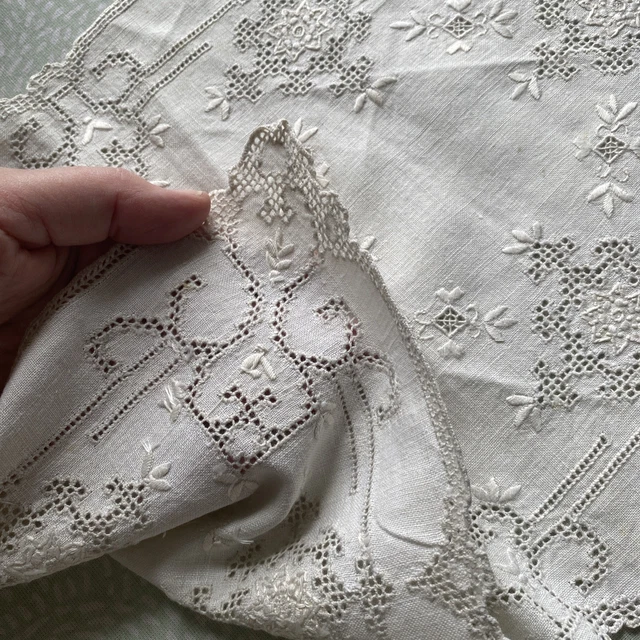
- Embroidery: satin-stitch monograms in white or red, drawn-thread borders (jours), and small red cross-stitch numbers in the corners.
- Prints: Provençal designs printed by hand block or roller, with the maker's name sometimes woven or printed on the selvedge.
The market: most wanted
- Complete sets of monogrammed linen damask: a large tablecloth with twelve or more matching napkins.
- Early Souleiado and other Provençal printed tablecloths with selvedge marks.
- Thick Basque linen tablecloths and towels with traditional bands of coloured stripes.
Authenticity: period piece or reproduction?
- Linen feels cool and heavy, creases sharply and softens to a sheen with washing; cotton feels warmer and duller.
- Hand embroidery has small knots and variations on the back; machine embroidery is identical on every piece, with a bobbin thread underneath.
- Old cloths show soft wear lines along the storage folds and slight yellowing that whitens again in a sun-bleach.
- Warning signs: polyester blends that will not crease, printed imitation embroidery, uniform 'vintage-wash' new linens and monograms unpicked from one set and added to another.
Where to buy
- In France: brocantes, vide-greniers, Leboncoin and the linen dealers of L'Isle-sur-la-Sorgue and Saint-Ouen, who sell trousseau sets by the dozen.
- In the US and UK: Etsy, eBay and specialist French linen dealers, plus Round Top for bundled lots of French linens.
Buyer's checklist
- Monogram matching
- Stains and holes
- Fibre type
- Set count
Facts
- Typical size
- Tablecloth 150×250–180×400 cm · napkins 50–80 cm square
- Weight
- 0.5–3 kg
- Period
- 1850–1960
- Materials
- Linen, métis (linen-cotton), cotton
- US search interest
- 340 searches a month
Collector interest
Table linen draws 340 monthly US searches, split into 9 keyword variants.
By style, searches lean to art deco (60), farmhouse (60), rustic (40), french country (30).
Searches by country of origin: french (40).
Related in Tables & Consoles
- Vintage Coffee Table
- Vintage Dining Table
- Antique Side Table
- Vintage Console Table
- Vintage End Table
- Vintage Kitchen Table
- Antique Vanity
- Antique Console
Go deeper: research notes
The Vintage Side Tables: An Identification Guide gathers 12 sourced object studies, including: