Tables & Consoles · identification & value
Antique Dressing Table
In 18th-century France, the toilette, the morning ritual of dressing and powdering, was a social event, and the poudreuse kept powders, combs and the mirror hidden under a neat top. Two centuries later, art deco designers gave the dressing table a round mirror, sweeping curves and luxurious veneers.
1750–1950
Typical asking price on live listings
about $165
Median of current eBay asking prices (via PicClick); listings run from $10 to $3,500. Asking prices are not sold prices.
Expert tip
Open the top of a French poudreuse: the centre panel should lift to reveal a mirror on a ratchet, and the two side flaps should open onto compartments for powders and brushes; missing mirror or fittings sharply reduce value.
History
- The poudreuse or coiffeuse developed under Louis XV and Louis XVI.
- Art deco dressing tables, often with round mirrors, were made by leading Paris designers in the 1920s and 1930s.
Where it comes from
Paris ébénistes for Louis XV and Louis XVI poudreuses (coiffeuses with a lifting central mirror); Paris art deco designers such as Jules Leleu and Émile-Jacques Ruhlmann; English Victorian and Edwardian makers for dressing tables with swing mirrors.
Details to look at
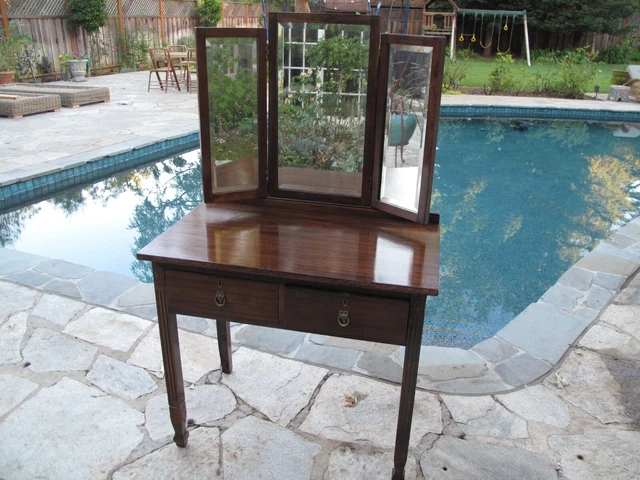
- Lifting mirror and compartments.
- Veneers and marquetry.
- Drawers and handles.
The market: most wanted
- 18th-century poudreuses with original fittings.
- Art deco dressing tables by Leleu or Ruhlmann.
- Fine Victorian and Edwardian satinwood dressing tables.
Authenticity: period piece or reproduction?
- Old mirrors with slight distortion and silver loss.
- Hand-cut dovetails and old locks.
- Veneers with natural wear.
- Warning signs: new mirrors, replaced handles and artificially aged veneers.
Where to buy
- Saint-Ouen and Proantic for poudreuses; Leboncoin for art deco coiffeuses.
- In the US, 1stDibs, Chairish and eBay.
Buyer's checklist
- Mirror
- Fittings
- Veneer
- Drawers
Facts
- Typical size
- H 70–150 cm (with mirror) · W 70–120 cm · D 40–55 cm
- Weight
- 20–60 kg
- Period
- 1750–1950
- Materials
- Walnut, rosewood, satinwood, mahogany, mirror glass
- US search interest
- 1,150 searches a month
Collector interest
Search demand for dressing table reaches 1,150 US searches a month across 64 distinct queries.
By style, searches lean to art deco (190), victorian (30), edwardian (10), shabby chic (10).
Origins in the queries: french (50).
Related in Tables & Consoles
- Vintage Coffee Table
- Vintage Dining Table
- Antique Side Table
- Vintage Console Table
- Vintage End Table
- Vintage Kitchen Table
- Antique Vanity
- Antique Console
Go deeper: research notes
The Vintage Side Tables: An Identification Guide gathers 12 sourced object studies, including: