Tables & Consoles · identification & value
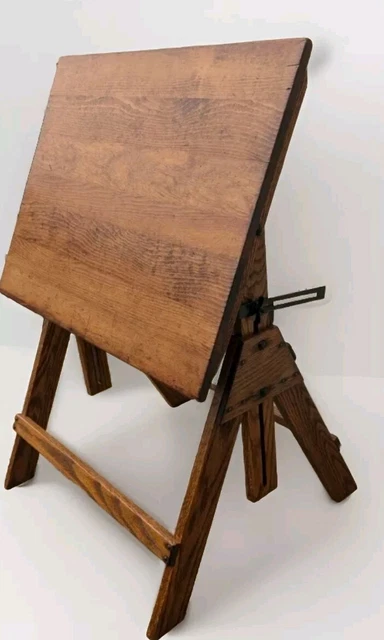
Vintage Drafting Table
Before computers, every bridge, building and locomotive began on a drafting board tilted toward the north light of an office window. Paris engineering schools and American factories kept rooms full of them, and when CAD arrived in the 1980s most went to the scrapyard. The survivors, with their cast-iron bases and ink-stained tops, now serve as desks and kitchen islands.
1890–1975
Typical asking price on live listings
about $100
Median of current eBay asking prices (via PicClick); listings run from $2.5 to $6,295. Asking prices are not sold prices.
Expert tip
Crank the height and release the tilt: a good table rises smoothly and locks firmly at every angle, and the top should be flat when you sight along its edge; a seized gear, a stripped ratchet or a twisted top are costly to fix.
History
- Adjustable drafting tables with cast-iron bases were made from the late 19th century as engineering and architecture became formal professions.
- Hamilton, Keuffel & Esser and Mayline were leading American makers through the 20th century; French workshops supplied architects and technical schools in the same period.
Where it comes from
French architects' tables (tables d'architecte) with oak or pine tops on cast-iron crank bases were made by Paris workshops for architects, engineers and schools, often unsigned; the collector names are American: Hamilton of Two Rivers (Wisconsin), Keuffel & Esser of Hoboken (New Jersey) and Mayline.
Details to look at
- Base: cast-iron pedestal or four legs, crank or wheel for height.
- Top: solid wood boards with breadboard ends, often showing pin holes and ink.
- Tilt hardware: ratchet, quadrant or friction lock, with maker's plate.
The market: most wanted
- French cast-iron architects' tables with crank and wheel adjustment.
- Hamilton and Keuffel & Esser tables in good working order with maker's plates.
- Large oak-topped tables with original hardware and patina.
Authenticity: period piece or reproduction?
- Original cast iron shows paint layers and casting texture; parts have matching wear.
- Tops are solid boards with breadboard ends; old pin holes and ink stains are a good sign.
- Maker's plates are riveted on and worn with the surface around them.
- Warning signs: new tops on old bases, decorative reproductions with cast resin parts, and missing gears or cranks.
Where to buy
- In France, Leboncoin, Saint-Ouen dealers in industrial furniture and school sales.
- In the US and UK, eBay, Etsy, Chairish and estate sales, especially in former industrial towns.
Buyer's checklist
- Tilt locks
- Height adjusts
- Top flat
- Maker's plate
Facts
- Typical size
- Top 90 × 60 cm to 150 × 100 cm · H 75–110 cm
- Weight
- 30–80 kg
- Period
- 1890–1975
- Materials
- Cast iron, oak, pine, maple, steel
- US search interest
- 1,600 searches a month
Collector interest
Drafting table draws 1,600 monthly US searches, split into 22 keyword variants.
The materials buyers name are wood (50), metal (10).
Searcher intent: 6% want to buy.
Related in Tables & Consoles
- Vintage Coffee Table
- Vintage Dining Table
- Antique Side Table
- Vintage Console Table
- Vintage End Table
- Vintage Kitchen Table
- Antique Vanity
- Antique Console
Go deeper: research notes
The Vintage Side Tables: An Identification Guide gathers 12 sourced object studies, including: