Tables & Consoles · identification & value
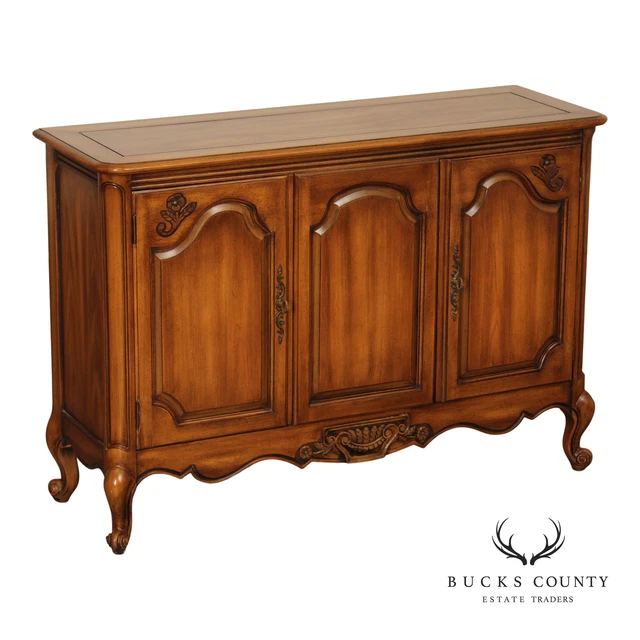
Antique Console Cabinet
In a French dining room the low cabinet against the wall, the buffet bas or enfilade, held the good plates and served as a sideboard for the meal. After the war, the same low form became a piece of entertainment furniture: a long walnut console with a radio, a turntable and a cocktail cabinet, the centre of the living room before television took over.
1750–1970
Typical asking price on live listings
about $1,075
Median of current eBay asking prices (via PicClick); listings run from $15 to $14,500. Asking prices are not sold prices.
Expert tip
Open the back or the doors and look at the back panel and shelf supports: an old French buffet bas has solid boards with plane or saw marks and wooden pegs; a 1950s radio-gram should still have its original chassis plate with the brand and model number.
History
- Low buffets and meubles d'appui were made in French provinces and in Paris through the 18th and 19th centuries; Art Deco ensembliers redesigned them in the 1920s–30s.
- Radio-gram consoles from Grundig, Telefunken and Philips were popular in Europe from the 1950s to the 1960s; the Braun SK 4 (1956) is the design icon.
Where it comes from
Paris for Art Deco and mid-century enfilades and meubles d'appui; Normandy, Brittany and the Alps for country buffets bas; Germany (Grundig, Telefunken, Braun) and the Netherlands (Philips) for the radio-gram and record-player consoles in many searches.
Details to look at
- Doors: carved panels on provincial buffets, veneered fronts on Art Deco pieces.
- Top: wood, marble, or a lid hiding a turntable.
- Interior: shelves, drawers, or radio and turntable compartments.
The market: most wanted
- Art Deco enfilades in macassar ebony or burr walnut by Paris ensembliers.
- Louis XV provincial buffets bas in walnut or oak.
- Braun and Grundig consoles in working condition.
Authenticity: period piece or reproduction?
- Provincial buffets are framed with pegged mortise-and-tenon joints; the long hinges (fiches) are forged iron or brass and have left oxidised outlines in the wood.
- Art Deco veneers are book-matched across the doors, and macassar or burr veneer is thicker than modern veneer, visible on a worn edge.
- Radio-gram consoles keep the chassis plate, the original speaker and a turntable of the same brand and era.
- Warning signs: a plywood back on a 'period' buffet, a cut-down armoire base sold as a buffet bas (look for sawn tops of the stiles), and gutted consoles with modern amplifiers but no mention of it.
Where to buy
- Saint-Ouen, L'Isle-sur-la-Sorgue and Proantic for French buffets and enfilades; Selency and Leboncoin for mid-century consoles.
- In the US, Chairish, 1stDibs and Round Top for French buffets; eBay and Facebook Marketplace for stereo consoles, which rarely ship well.
Buyer's checklist
- Back panel
- Hinges
- Veneer lifting
- Electronics
Facts
- Typical size
- L 120–250 cm · D 40–55 cm · H 80–100 cm
- Weight
- 40–120 kg
- Period
- 1750–1970
- Materials
- Walnut, oak, macassar ebony, veneers, marble
- US search interest
- 290 searches a month
Collector interest
Console cabinet draws 290 monthly US searches, split into 10 keyword variants.
Style words in the queries: farmhouse (50), rustic (30), art deco (10), french country (10).
Searches by country of origin: french (10).
Related in Tables & Consoles
- Vintage Coffee Table
- Vintage Dining Table
- Antique Side Table
- Vintage Console Table
- Vintage End Table
- Vintage Kitchen Table
- Antique Vanity
- Antique Console
Go deeper: research notes
The Vintage Side Tables: An Identification Guide gathers 12 sourced object studies, including: