Tables & Consoles · identification & value
Antique Breakfast Table
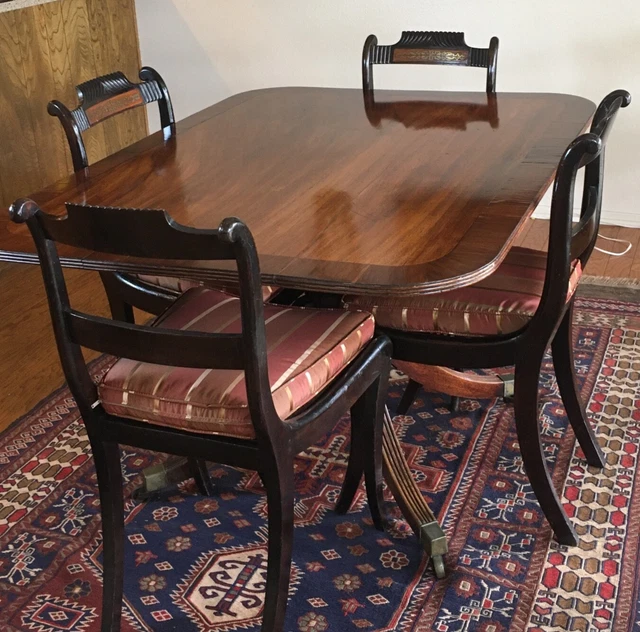
In a Regency household, breakfast was taken in a small room near the morning light, at a round or oval table on a single pedestal. After the meal, the top was tipped vertical and the table pushed against the wall. The French had their own versions: walnut guéridons in Louis-Philippe salons and plain fruitwood tables in country kitchens.
1790–1900
Typical asking price on live listings
about $46
Median of current eBay asking prices (via PicClick); listings run from $2.5 to $7,500. Asking prices are not sold prices.
Expert tip
Tip the top up and look at the underside: on a genuine tilt-top, the cleats and the brass catch have left clear shadow lines, and the screw holes match only one set of fittings; extra holes or fresh wood show a top married to another base.
History
- English tilt-top breakfast tables flourished in the Regency period (about 1800–1830) in mahogany and rosewood, with four splayed legs and brass castors.
- French Louis-Philippe (1830–1848) pedestal tables in walnut or mahogany served as breakfast and centre tables; provincial fruitwood tables continued through the 19th century.
Where it comes from
London and provincial England for Regency mahogany and rosewood tilt-top breakfast tables; in France, the walnut and cherry pedestal tables (guéridons) of the Louis-Philippe period and fruitwood farmhouse tables from Burgundy, the Bresse and Provence.
Details to look at
- Top: one-piece or two-board, figured mahogany or rosewood veneer, cross-banding and edge moulding.
- Mechanism: brass snap catch and pivot block on English tilt-tops.
- Base: turned column, four splayed legs with brass castors, or tripod.
The market: most wanted
- Regency rosewood and mahogany breakfast tables with original castors.
- Louis-Philippe walnut pedestal tables with figured tops.
- French fruitwood round tables with drawer from Burgundy or Provence.
Authenticity: period piece or reproduction?
- Measure the top twice at right angles: solid wood shrinks across the grain, so a round top that is 1–2 cm narrower one way is a good sign of age.
- Regency castors are cast brass cups with leather or brass rollers, often stamped with a patent mark; plastic or steel wheels are replacements.
- Veneers should have faded the same honey or pale tone on top and base; a dark base under a bleached top suggests a marriage.
- Warning signs: tops cut down from larger tables (look for fresh edges under the moulding), a column with new pegs, and thick modern polyurethane finishes.
Where to buy
- Saint-Ouen, Proantic and regional brocantes for French guéridons; Leboncoin and Burgundy and Provence dealers for fruitwood tables.
- In the US and UK, 1stDibs, Chairish, English country-house sales, Bonhams and regional auction houses for Regency tables; eBay for smaller tables.
Buyer's checklist
- Under-top marks
- Catch and pivot
- Castors
- Top shrinkage
Facts
- Typical size
- Ø 100–140 cm · H 72–76 cm
- Weight
- 25–60 kg
- Period
- 1790–1900
- Materials
- Mahogany, rosewood, walnut, cherry, oak, brass
- US search interest
- 220 searches a month
Collector interest
Breakfast table draws 220 monthly US searches, split into 9 keyword variants.
By style, searches lean to rustic (20), french country (20).
Searches by country of origin: french (40), english (30).
Related in Tables & Consoles
- Vintage Coffee Table
- Vintage Dining Table
- Antique Side Table
- Vintage Console Table
- Vintage End Table
- Vintage Kitchen Table
- Antique Vanity
- Antique Console
Go deeper: research notes
The Vintage Side Tables: An Identification Guide gathers 12 sourced object studies, including: