Racks & Wall Storage · identification & value
Vintage Wall Shelf
In a Provençal kitchen, pewter plates and jugs were displayed on an estagnié, a carved wall rack with scalloped sides and a rail to keep the plates in place. It showed off the family's best ware and kept it within reach.
1750–1960
Typical asking price on live listings
about $98
Median of current eBay asking prices (via PicClick); listings run from $9.99 to $3,975. Asking prices are not sold prices.
Expert tip
Look at the back boards: hand-planed boards show shallow scalloped tool marks and are fixed with cut nails with rectangular heads; machine-planed boards with wire nails point to the 20th century.
History
- Wall racks and shelves were made by village carpenters across France in the 18th and 19th centuries; the estagnié is typical of Provence.
- Art Deco and 1950s designers revived the wall shelf in wrought iron, lacquered wood and perforated metal.
Where it comes from
Provence for the estagnié, the scalloped wall rack made to display pewter; Normandy and the Alps for oak and pine plate racks; Paris for Art Deco shelves and the perforated-metal shelves of Mathieu Matégot in the 1950s.
Details to look at
- Side panels: scalloped, pierced or carved with scrolls on Provençal racks; plain shaped sides on Normandy and Alpine plate racks.
- Plate rails and grooves cut into the shelves, so plates and pewter could stand upright for display.
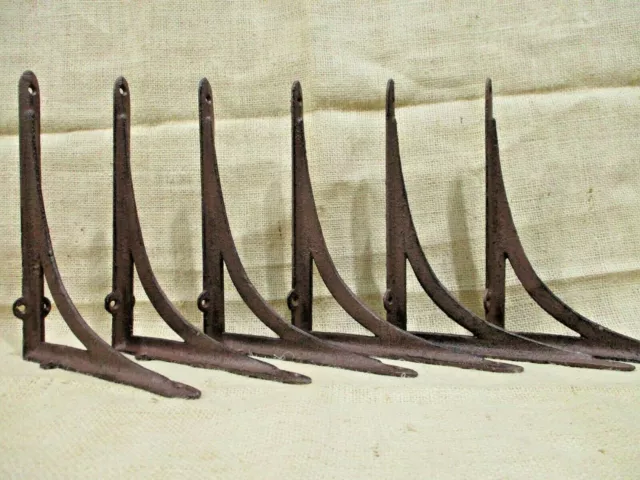
- Iron shelves: hammered scroll brackets on Art Deco pieces, perforated and folded sheet metal on 1950s designs.
The market: most wanted
- Provençal estagniés in walnut with carved and pierced sides, ideally with old pewter grooves.
- Mathieu Matégot pieces in perforated sheet metal with their original lacquer.
- Art Deco wrought-iron and marble shelves, and corner shelves (étagères d'angle) in fruitwood.
Authenticity: period piece or reproduction?
- Old wood has darkened, rounded edges and a worn front lip where plates were lifted on and off for generations.
- Hand-forged iron shows hammer marks and forge-welded or riveted joints rather than smooth weld beads.
- Matégot's perforated metal has neat, even perforations and folded edges, with original paint showing wear on the corners.
- Warning signs: new pine stained dark to look like walnut, MIG weld beads on 'antique' iron, and new reproductions of Matégot designs sold as period.
Where to buy
- Regional brocantes in Provence, L'Isle-sur-la-Sorgue and Leboncoin for estagniés and plate racks; Saint-Ouen and Proantic for Art Deco and 1950s pieces.
- In the US and UK, Chairish, Etsy and 1stDibs for French shelves; check that wall fixings are strong enough for the weight of displayed plates.
Buyer's checklist
- Back boards
- Nails
- Iron joints
- Wall fixings
Facts
- Typical size
- W 50–120 cm · H 40–100 cm · D 12–25 cm
- Weight
- 3–20 kg
- Period
- 1750–1960
- Materials
- Walnut, oak, pine, wrought iron, perforated sheet metal
- US search interest
- 390 searches a month
Collector interest
Wall shelf draws 390 monthly US searches, split into 10 keyword variants.
Style words in the queries: art deco (50), french country (50), farmhouse (10), chinoiserie (10).
The materials buyers name are wrought iron (90).